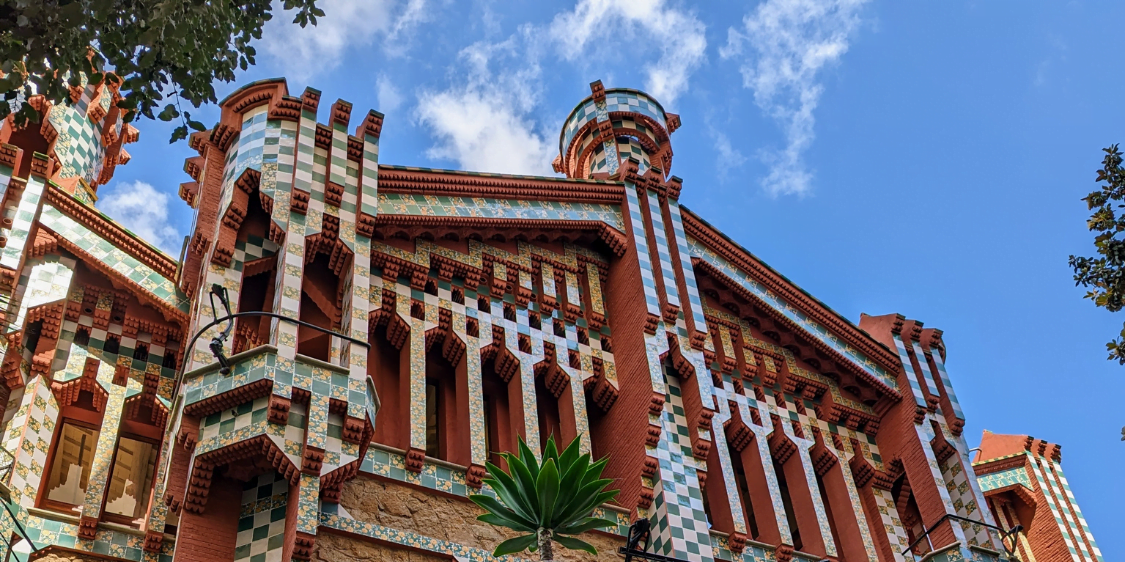
In the Gràcia district, behind a palm-leafed wrought-iron gate, liesone of Barcelona’s best-kept secrets: Casa Vicens. Designed by Antoni Gaudí, this surprisingly colorful building marked the beginning of his career. It’s alsoone of Barcelona’s most emblematic modernist buildings.
Casa Vicens in a nutshell
Casa Vicens was Antoni Gaudí’s first project to result in a building. The young architect applied all his knowledge and influences to the project. In it, he expresses his own vision of individual housing, where construction and decoration cannot be considered without each other.
Genesis of the project
Antoni Gaudí (1852 – 1926) studied architecture in Barcelona while working as a draughtsman to pay for his studies. After graduating in 1878, it wasn’t long before he was working on his first projects, such as lampposts for Place Royale.
That same year, Manuel Vicens i Montaner, a wealthy stockbroker, commissioned Gaudí to build a second family summer residence in Gràcia, then independent from Barcelona. At the time, many middle-class families chose this barely urbanized agricultural area as their second home.
Situated between an adjoining convent and a dead-end alley, the original plot covers an area of around 1000m2. To optimize space, Gaudí designed a single-family dwelling with three facades, a basement serving as a storeroom, two floors for the living areas, attic space for the household staff and a roof terrace.
Although Gaudí completed the project in 1880, the plans were signed and deposited with Gràcia Town Hall in 1883, marking the start of the two-year construction period.
Neo-Mudejar style
The Casa Vicens project marks the beginning of Gaudí’s innovative architecture, which combines a relatively simple architectural structure, in which straight lines take precedence over curved ones, with the complexity of highly meticulous decoration.
Stylistically, the work is part ofGaudí’s Orientalist phase(1883-1888), during which the architect produced a series ofworks in a resolutely Oriental style, inspired by the art of the Near andFar East, but also byHispano-Moorish art, principally Mudéjar.
Appearing in Spain in the 19ᵉ century, mainly following the rediscovery and appreciation of the country’s Islamic past, the neo-Mudejar style reinterprets the characteristic elements of medieval Hispano-Muslim architecture, such as decorative tiles, geometric friezes, floral motifs and the use of brick and plaster to create ornamental, colorful facades. In Spain, several buildings illustrate the neo-Mudejar style, such as the Palau de la Música Catalana in Barcelona.
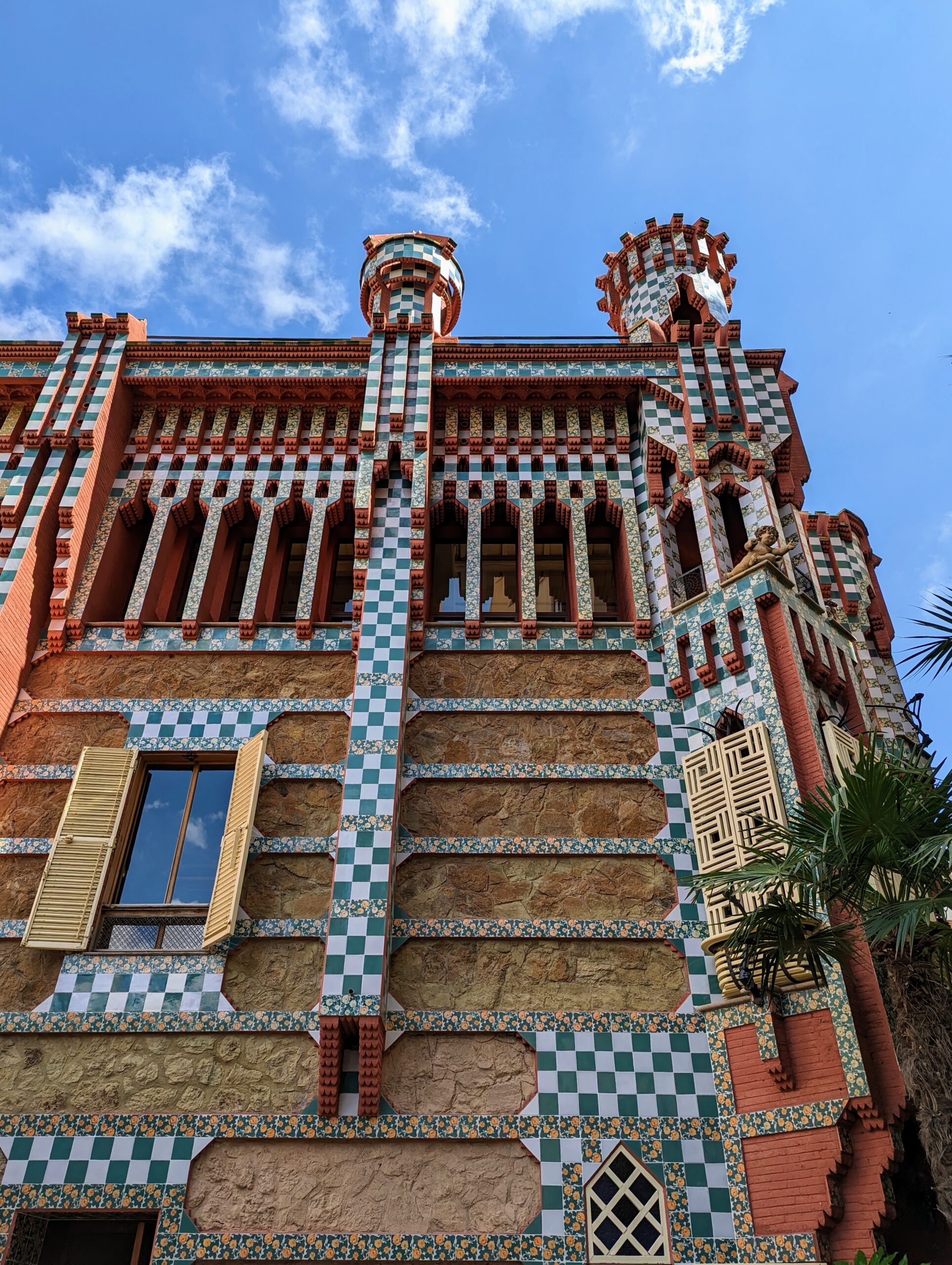
Although Casa Vicens is not considered a strict example of neo-Mudéjar, it reveals a rich diversity of motifs, shapes and colors, embracing the creativity and innovation characteristic of Gaudí’s early work. Among the house’s most distinctive features, the towers and chimneys are reminiscent of the architecture of the Alhambra.
Extensions and restoration
In 1925, the new owner of Casa Vicens, Dr. Jover, planned to enlarge the building to make it his main residence. He acquired two plots of land adjacent to the property, including one adjoining the party wall with the convent, with the intention of creating a new (fourth) façade for the house. Gaudí, who was devoting all his time to the Sagrada Família, refused the project and proposed one of his disciples, Joan Baptista Serra, to replace him.
Respecting Gaudí’s style, Serra built the right half of the building and a turret similar to the one already erected by Gaudí. Inside, the finishes chosen by Serra are simpler: mosaic floors, painted plaster walls and plaster false ceilings edged with molding.
In 1927, Barcelona City Council awarded Casa Vicens the prize for the most beautiful building for Serra’s renovation and extension.
The property was enlarged again in 1935, but the size of the garden was subsequently reduced when land was sold to build housing nearby.
In July 2005, Casa Vicens was declared a UNESCO World Heritage Site, along with the Nativity façade, the crypt and apse of the Sagrada Família expiatory temple, Casa Batlló, Park Güell, Palau Güell, Casa Milà and the crypt of Colònia Güell in Santa Coloma de Cervelló.
In 2014, the Herrero Jover family sold Casa Vicens to the MoraBanc bank, which undertook redevelopment work to transform the building into a house museum. It opens its doors to the public in November 2017. Overshadowed by other buildings such as La Pedrera and Casa Batlló, and eclipsed by El Capricho as Gaudí’s first creation, Casa Vicens is nonetheless considered Catalonia’s first modernist masterpiece. After it opened to the public, TIME magazine recognized the building asone of the 100 best places to visit in the world. Preview images below 😉
Visit Casa Vicens
Built according to traditional Catalan methods, a far cry from Gaudí’s future constructions based on regulated geometry, Casa Vicens has 4 floors over 1239m2. The simplicity of the house’s structure, based on a straight line, is softened by the architect’s decorative richness and overflowing imagination.
Exterior facades
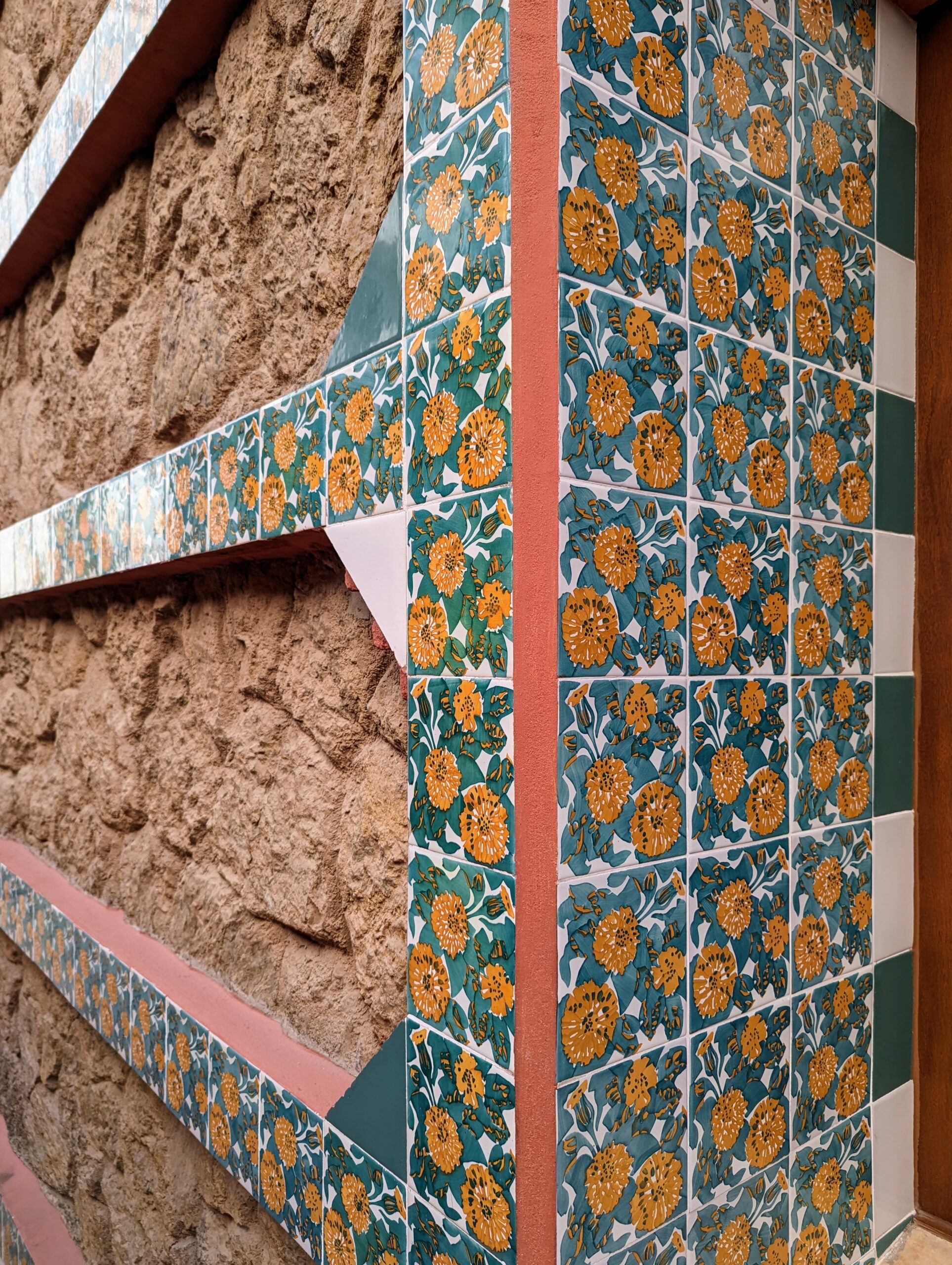
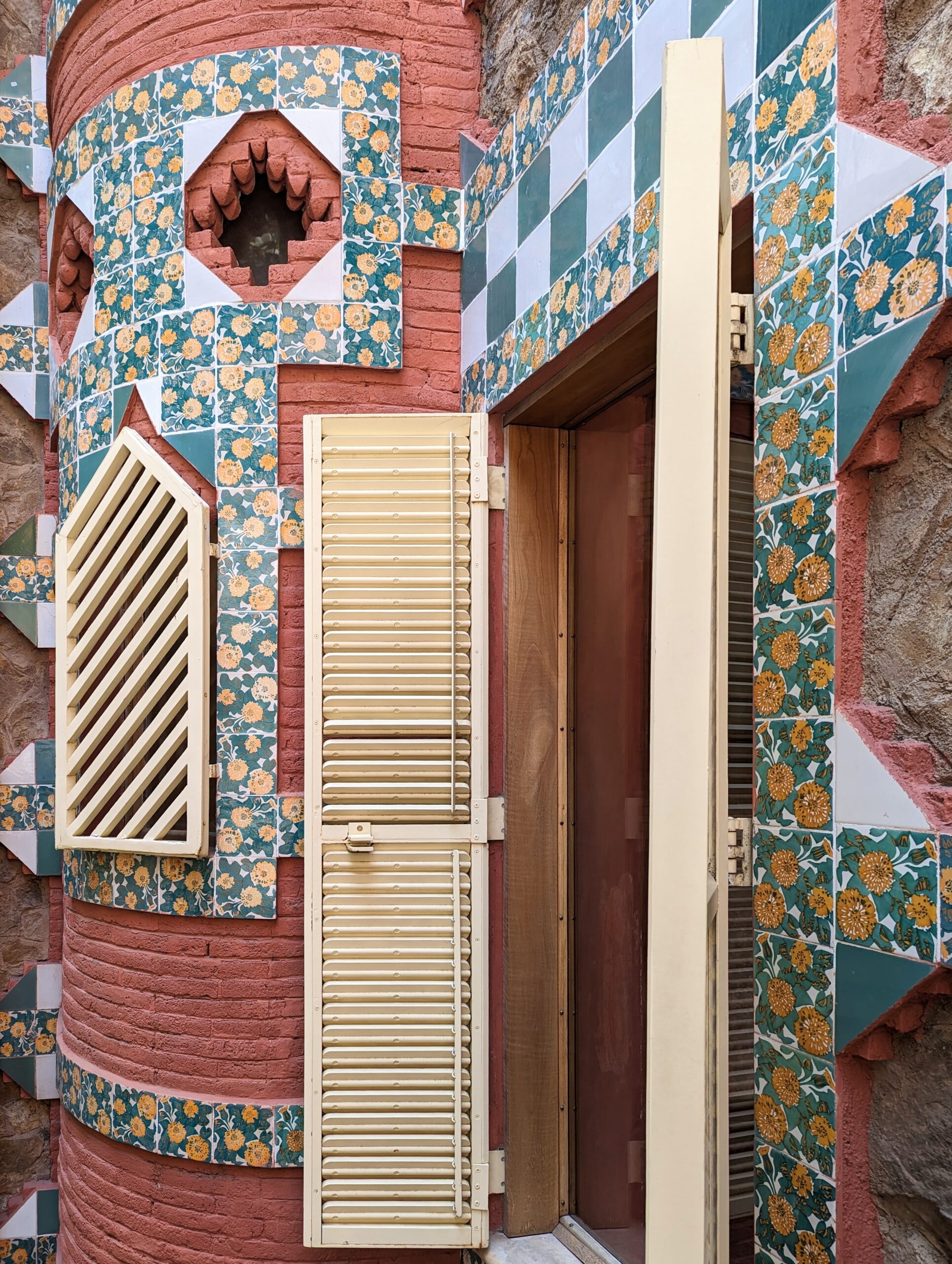
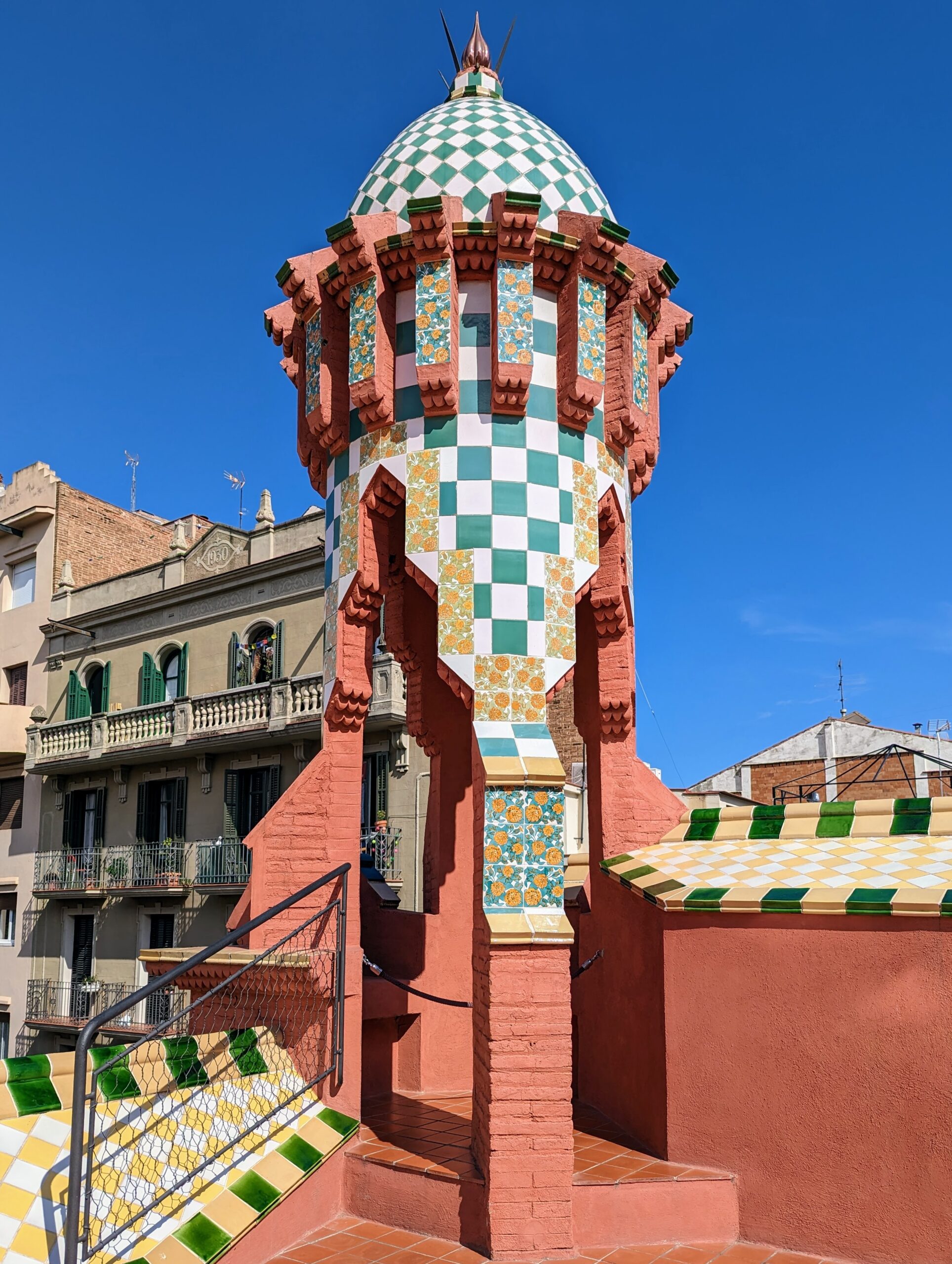
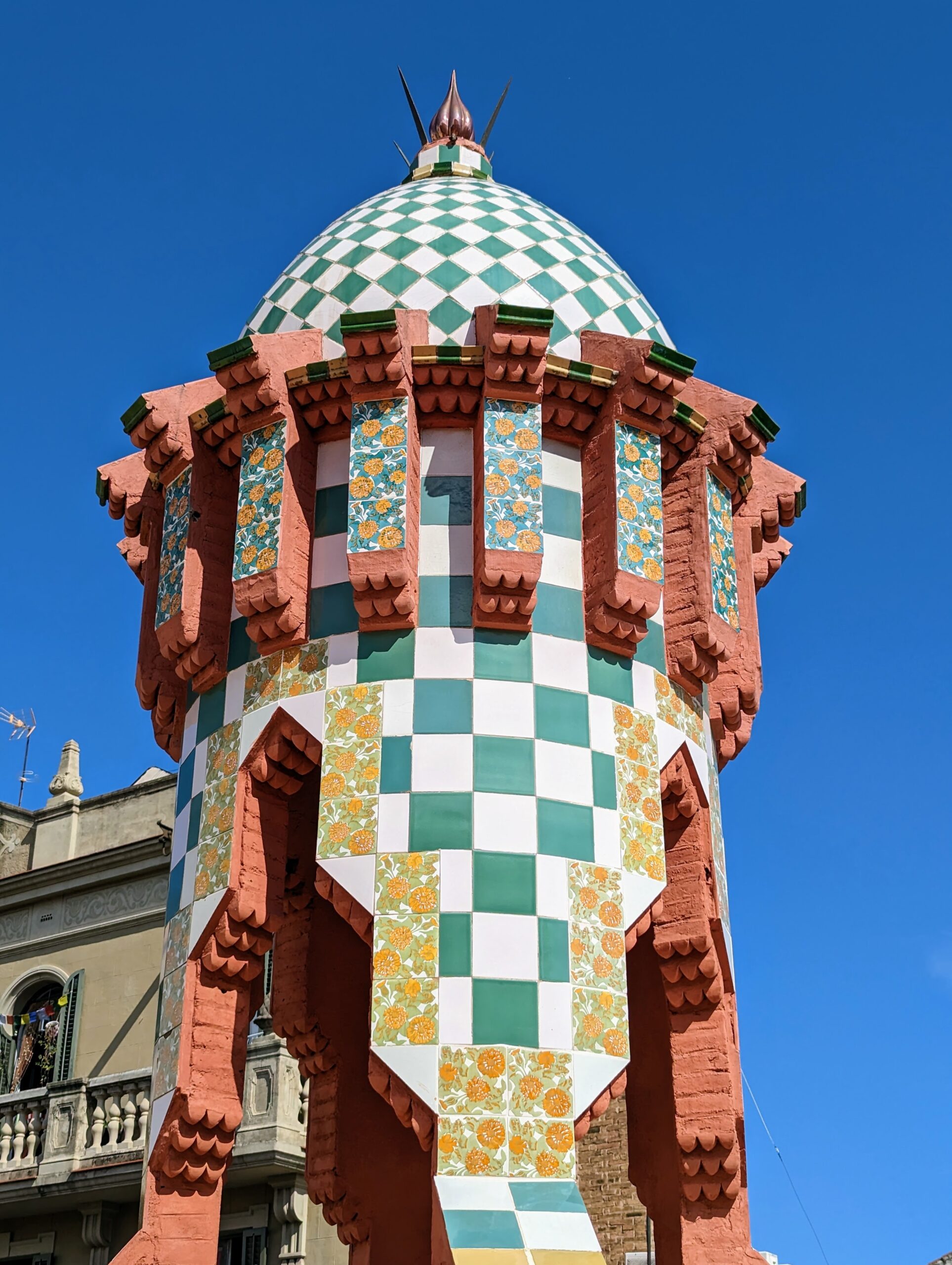
The exterior walls of Casa Vicens are of alternating masonry with rows of ceramic tiles. Some, in green and white, are in the shape of a chessboard, while others reproduce marigolds, the yellow flowers found by Gaudí on the grounds of the house before it was built.
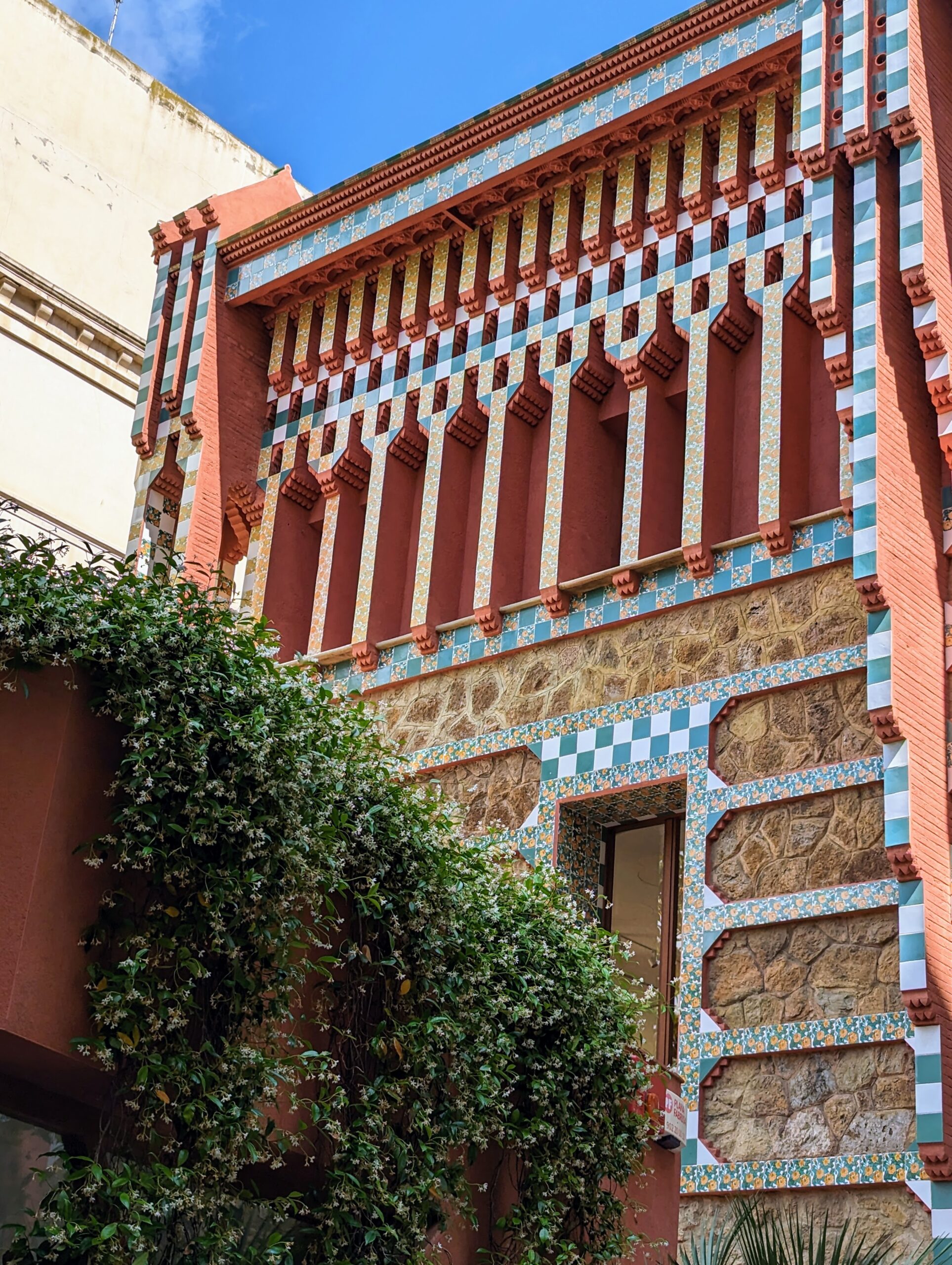
On the second floor, the facades feature a continuous gallery of mitered arches surrounding the upper section. The balcony sills are adorned with terracottaputti (chubby, mocking infants) and the window projections are edged with pyramid-shaped drops, alternating with shell and plant motifs.
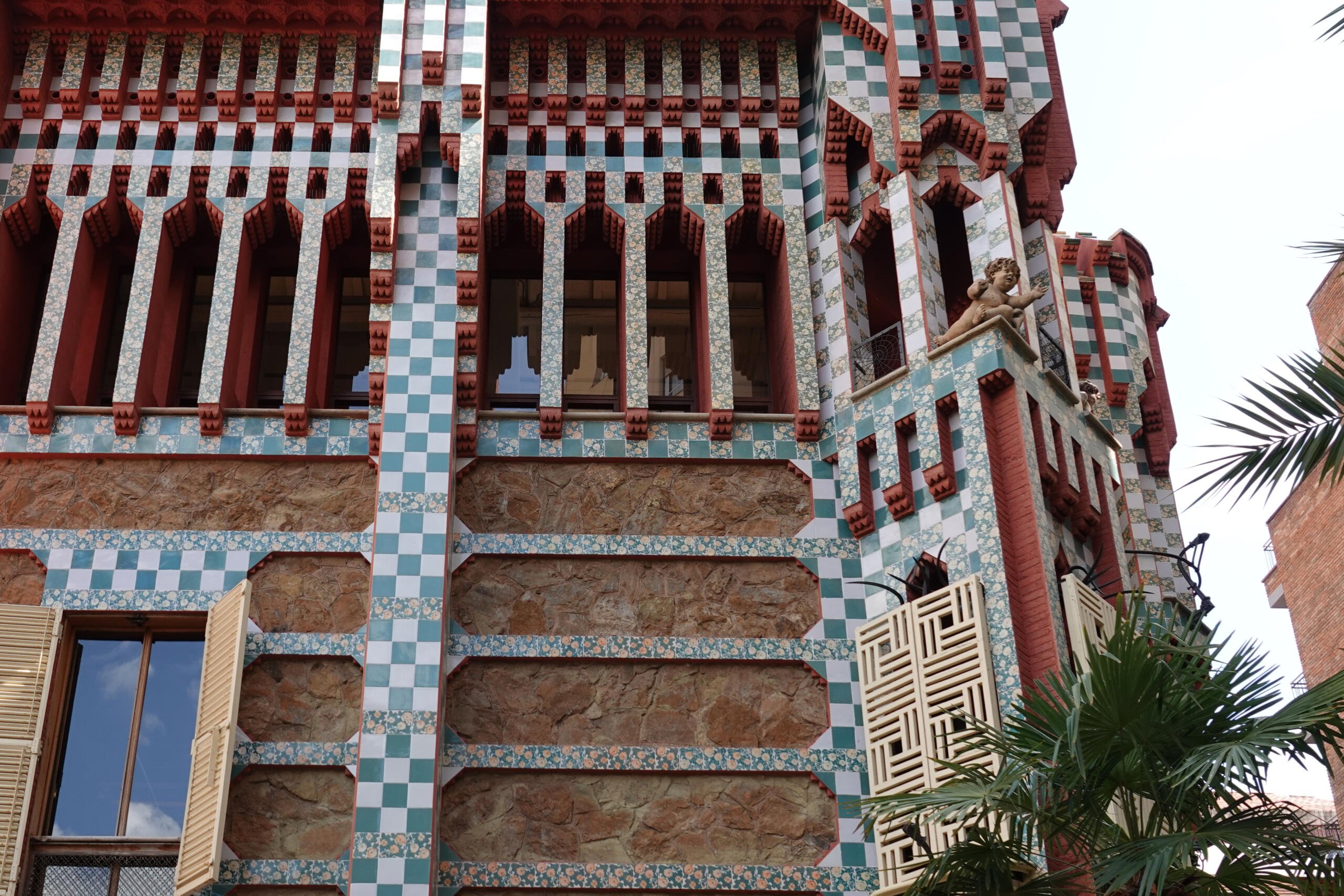
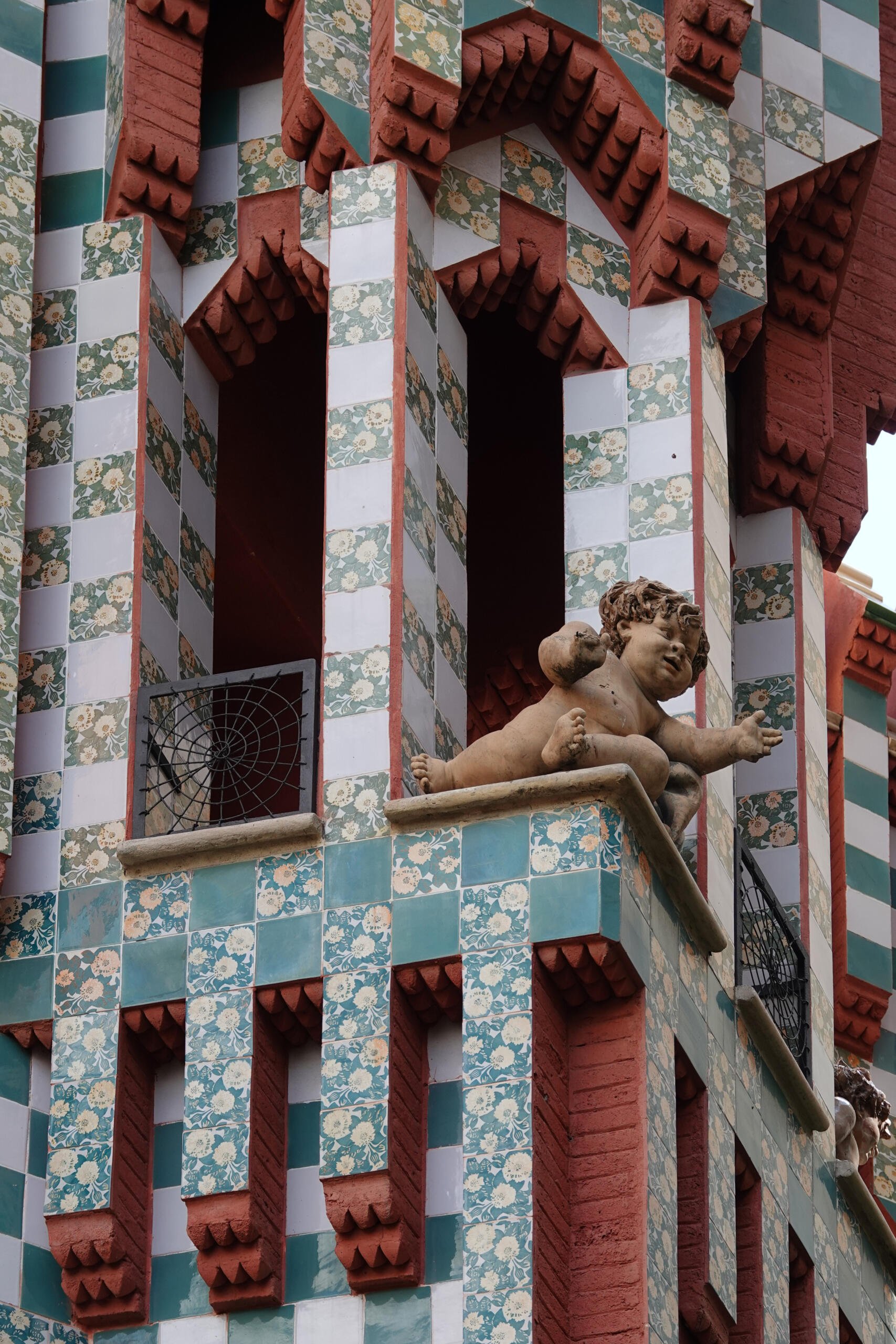
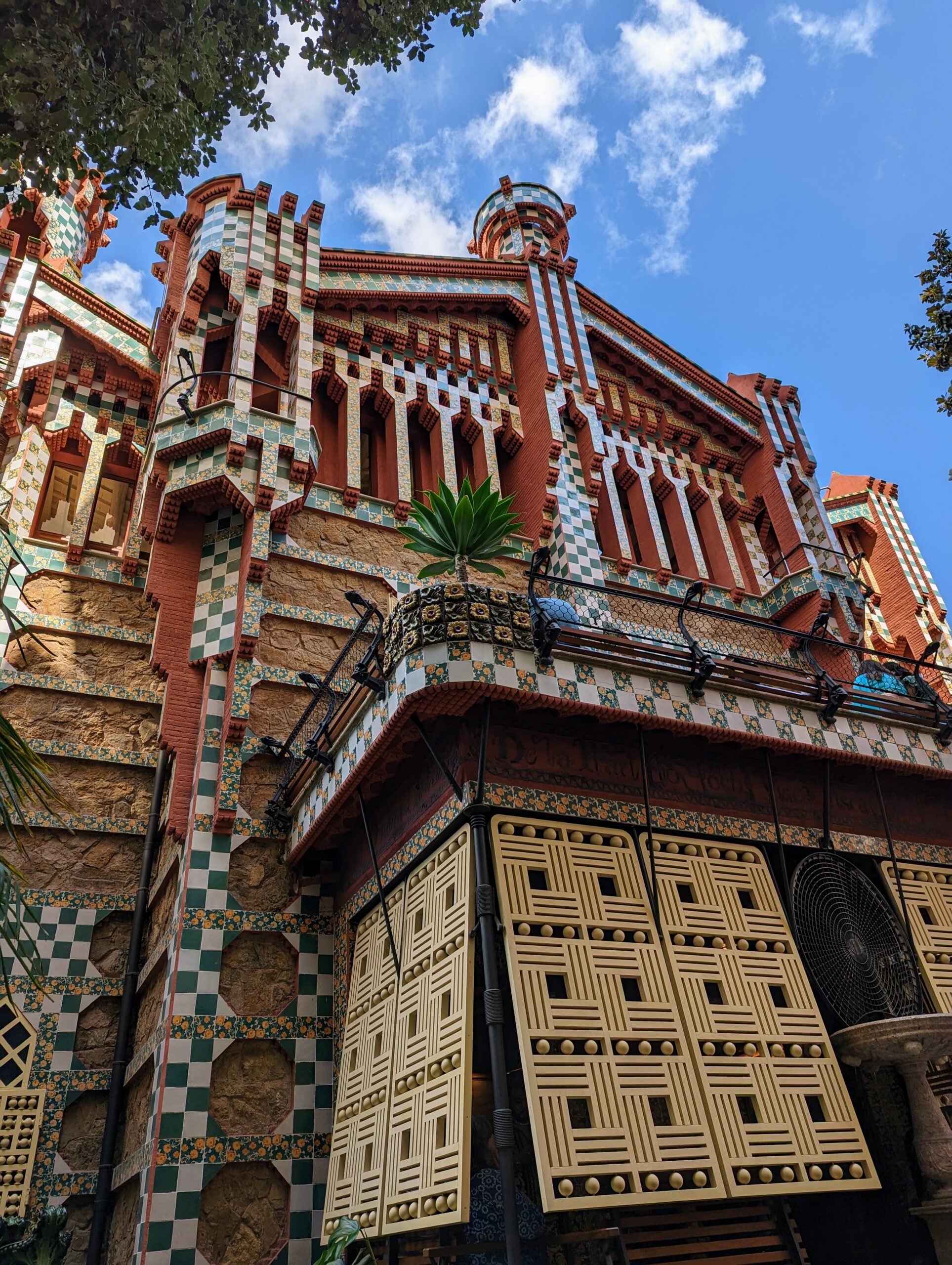
Structured on three levels, the garden facade is the main facade of Gaudí’s project. At the time of its creation, this façade enjoyed a much wider perspective, as the garden was much larger than it is today.
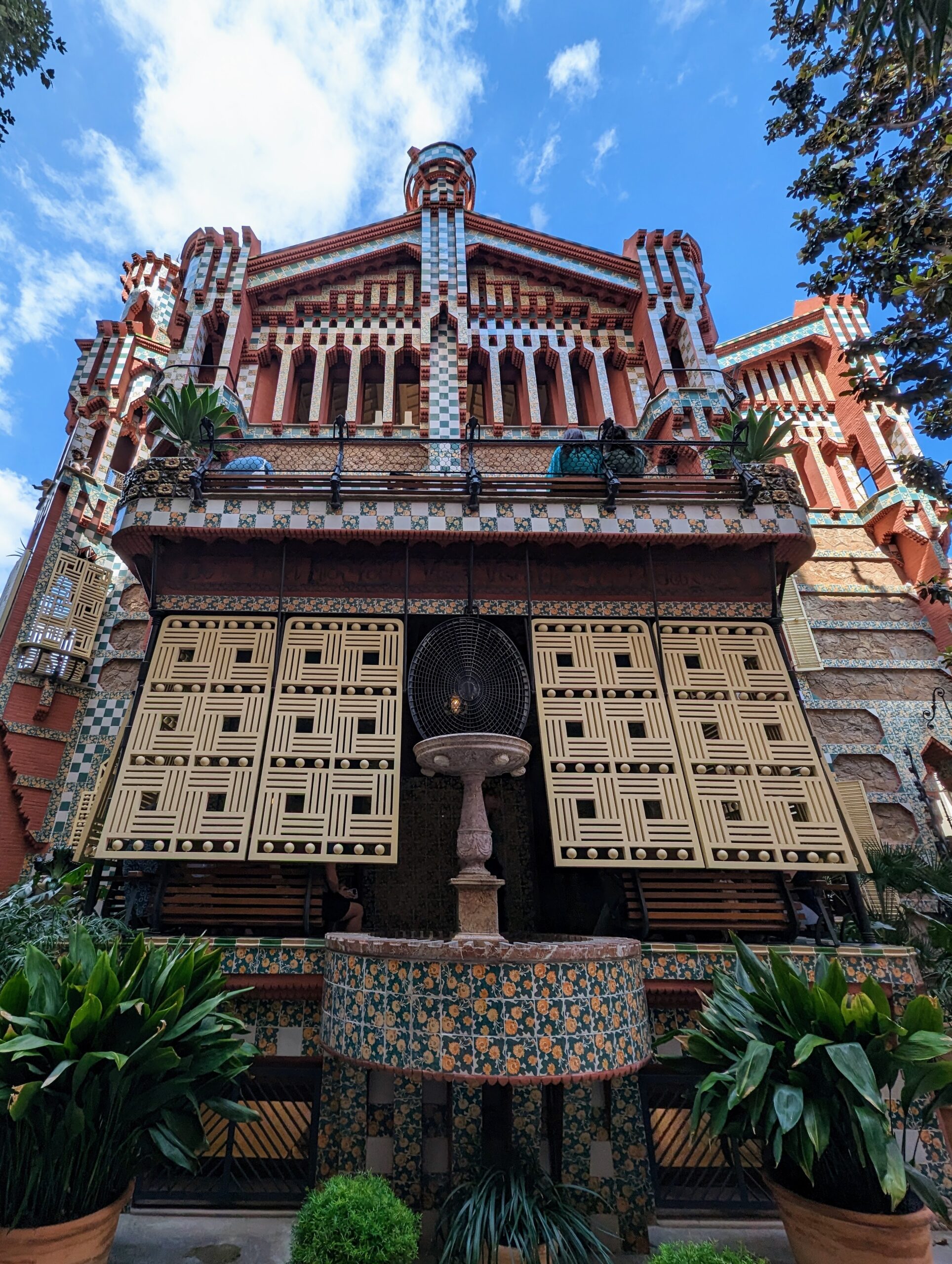
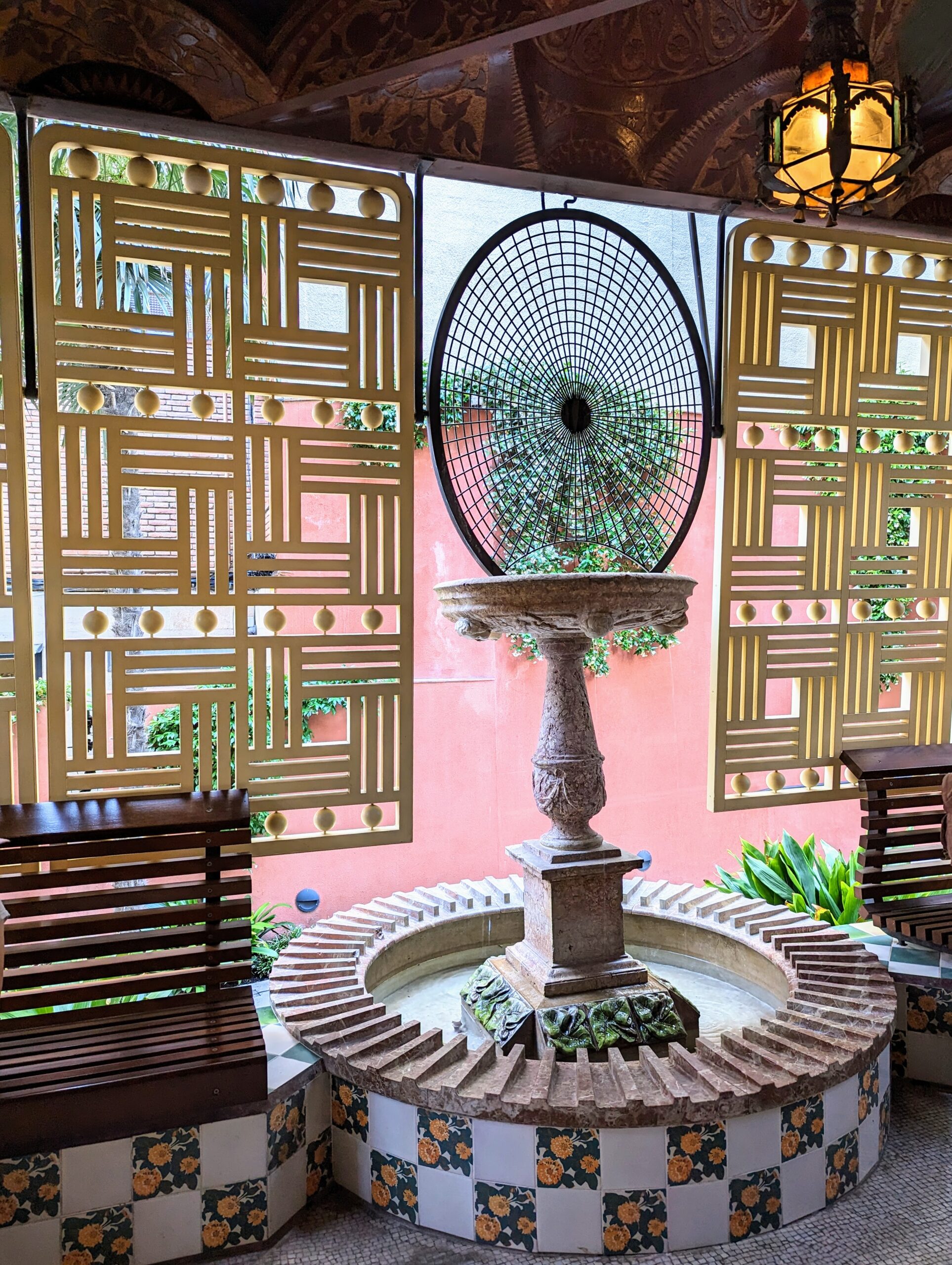
On the first floor, a bay window leads to the dining room. Its openings are closed by Japanese-inspired wooden blinds. In the center, a fountain rests on a base also covered with ceramic tiles adorned with carnations.
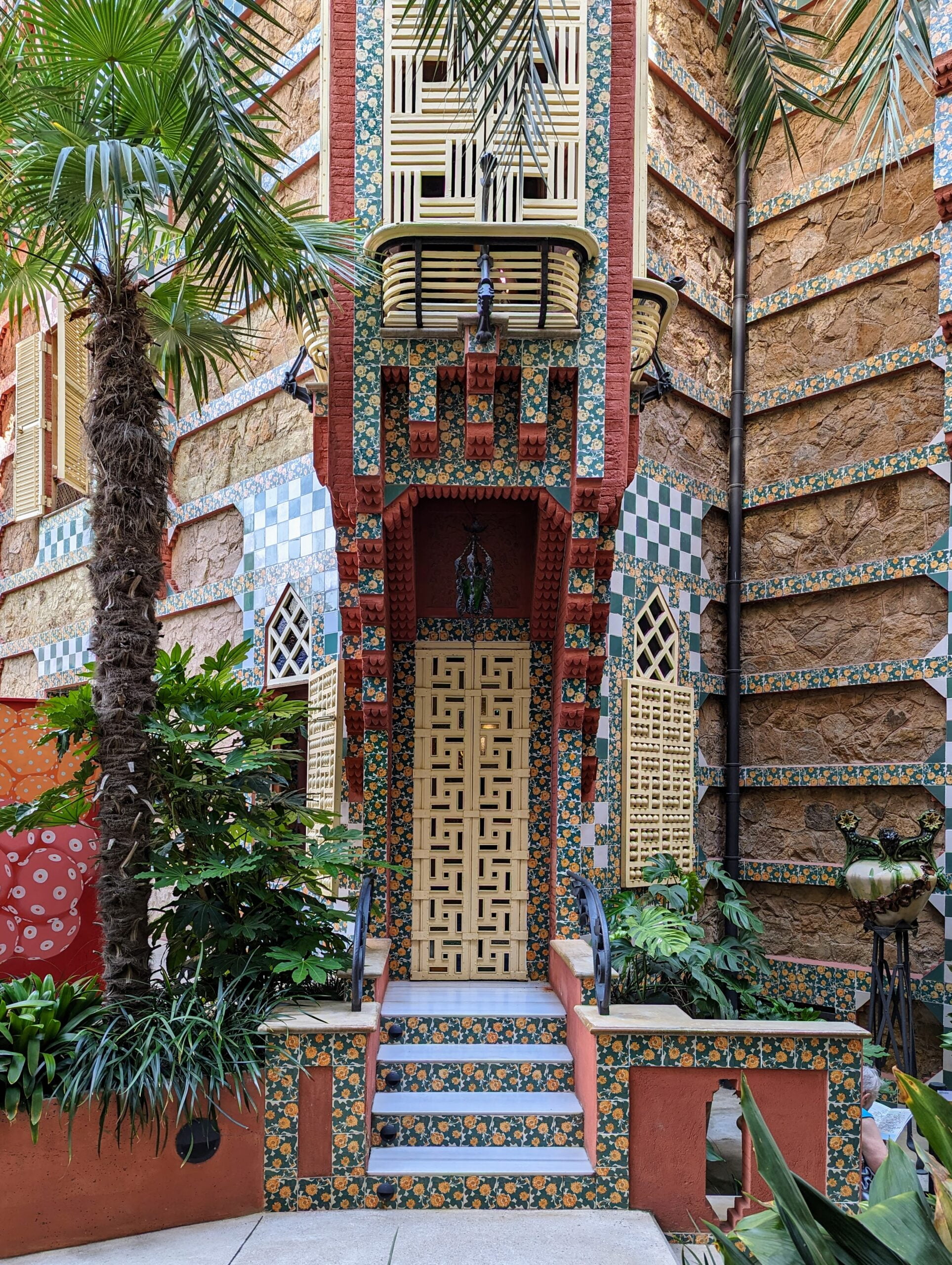
Formerly located on the street façade, the house’s main entrance door dates from the 1925 renovation. Raised off the ground, it is accessed via a flight of steps with a metal railing.
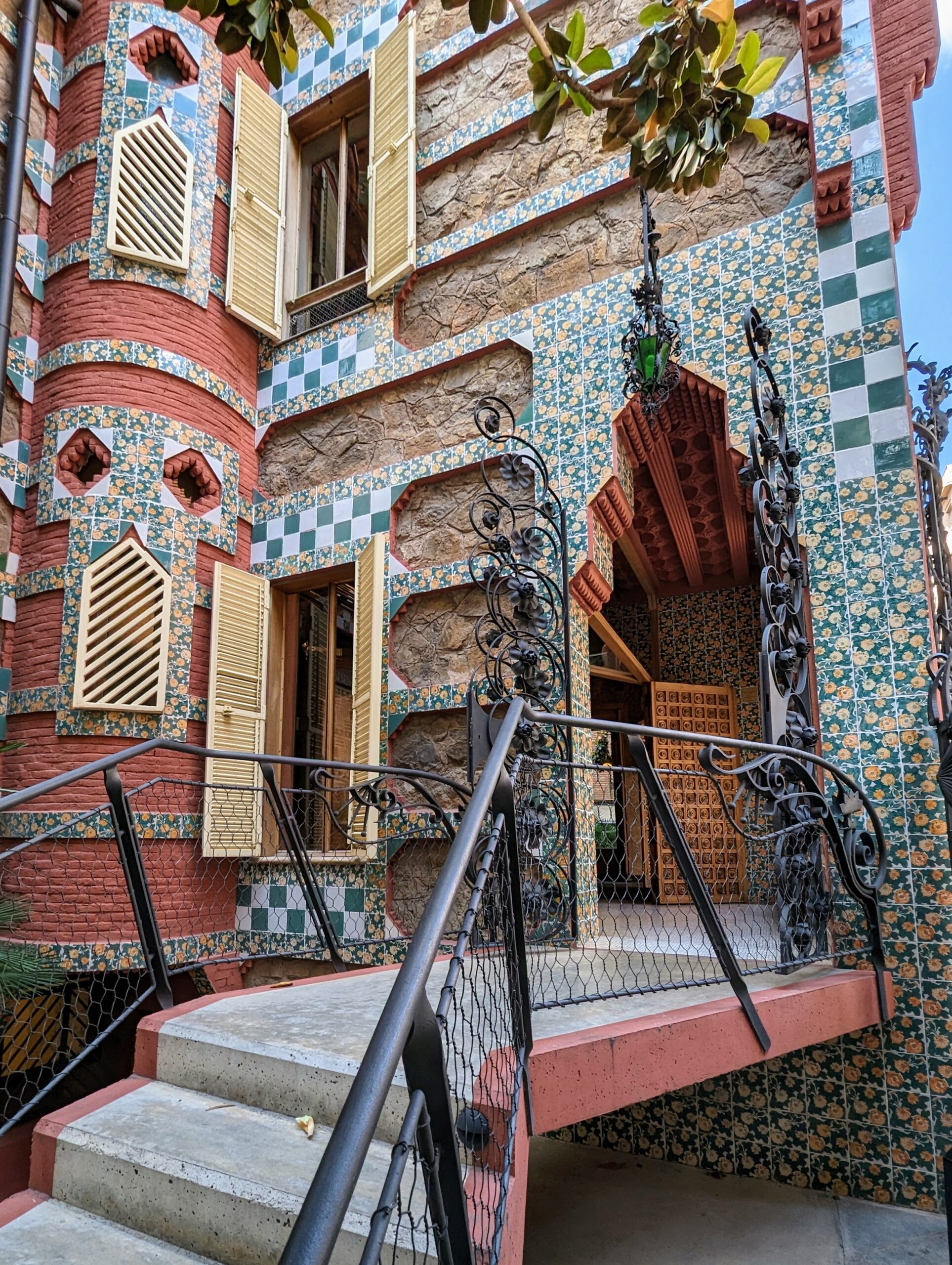
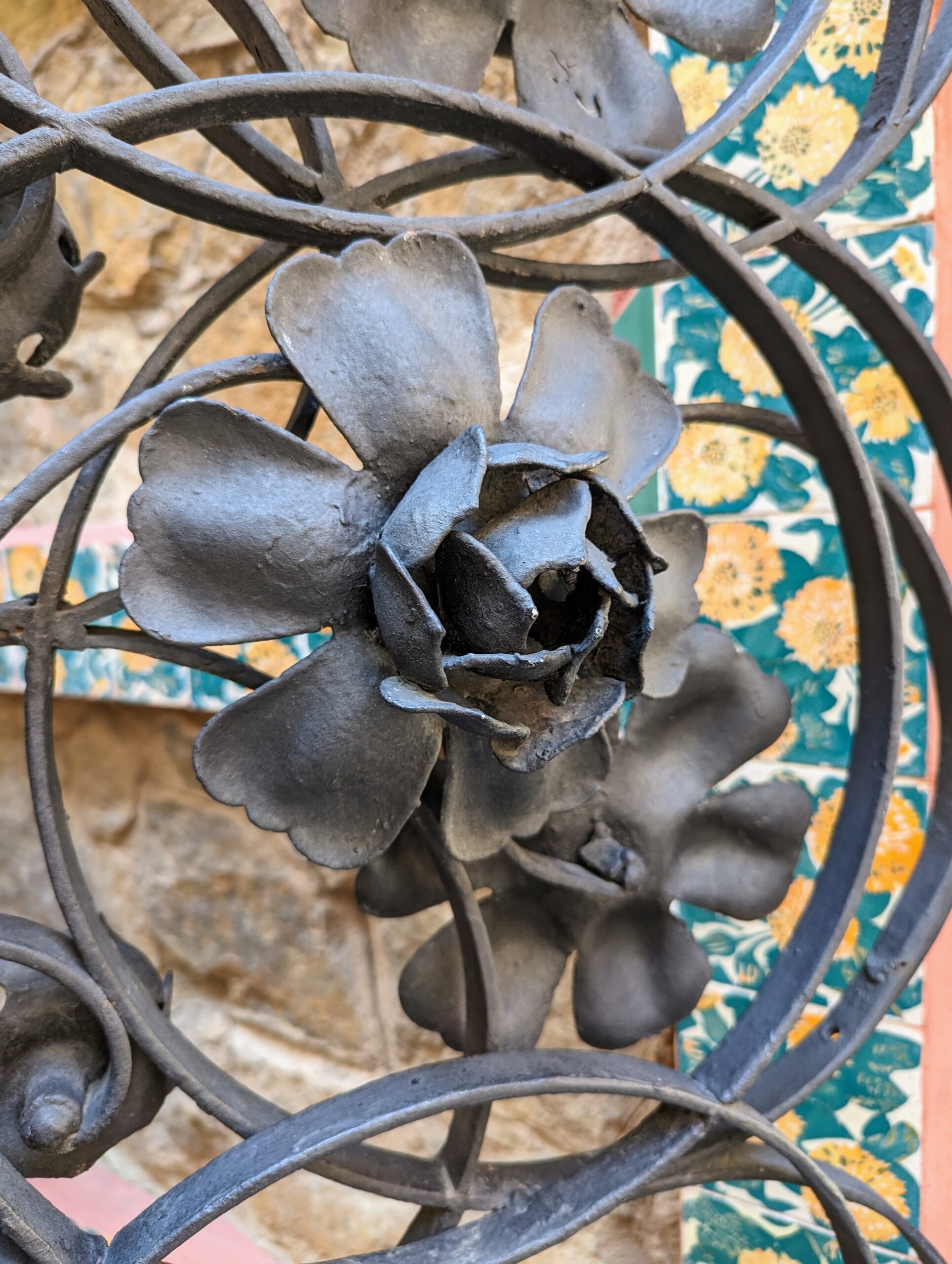
On either side of the door, wrought-iron wings are decorated with floral motifs. The top of the door is a straight mitered arch, decorated with large drops.
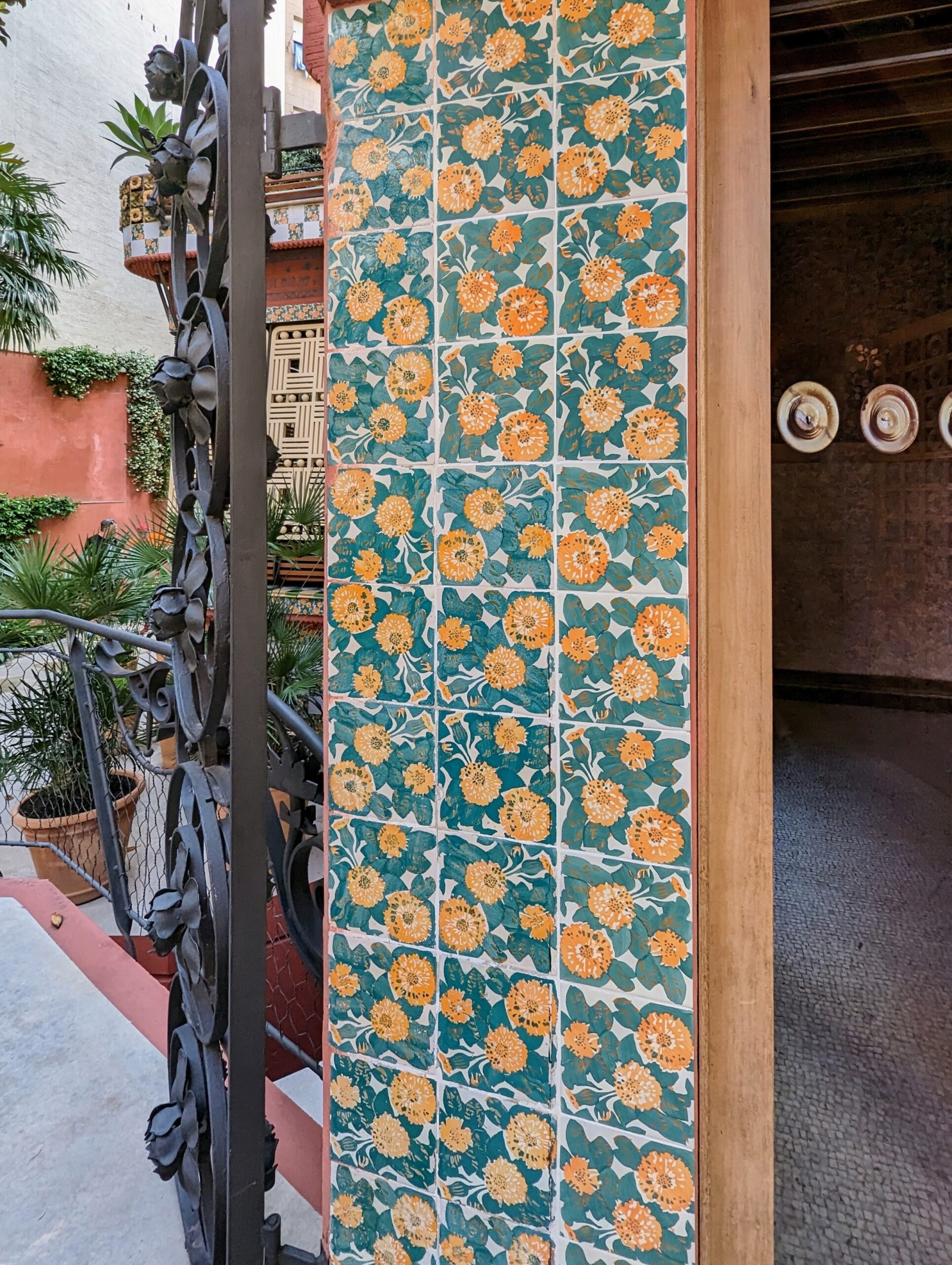
Access to the smoking room is via a flight of four steps decorated with ceramic tiles, while the wooden door features oriental geometric shapes reminiscent of the jalousies on the adjoining bay window.
Flat roof
It was at Casa Vicens that Gaudí created his first roof terrace.
A veritable belvedere, the roof terrace has a surface area of 150m2, 85m2 of which corresponds to the original house designed by Gaudí. The original part features four inclined planes built on the wooden beams of the attic roof, covered with rows of hollow tiles to collect rainwater. Also on the roof: two turrets and three brick structures serving as caps for the house’s chimneys, all covered with ceramic tiles combining carnations and green and white checkerboard.
Inside Casa Vicens
The interior of the house is designed to be functional, with each floor having a specific use: the basement for the storeroom; the main floor for reception areas and living rooms (kitchen, dining room); the second floor for bedrooms and bathrooms; the attic for the household staff. The different rooms are separated by small hexagonal vestibules, which allow them to be isolated from each other by closing the doors. All interior walls are masonry, with flat vaults in the basement and ceilings decorated with polychrome wooden beams on the other floors, in keeping with the Arab style that characterizes the building.
Noble floor
Access to the house is on the main floor, via a porch whose walls are entirely covered in ceramic tiles.
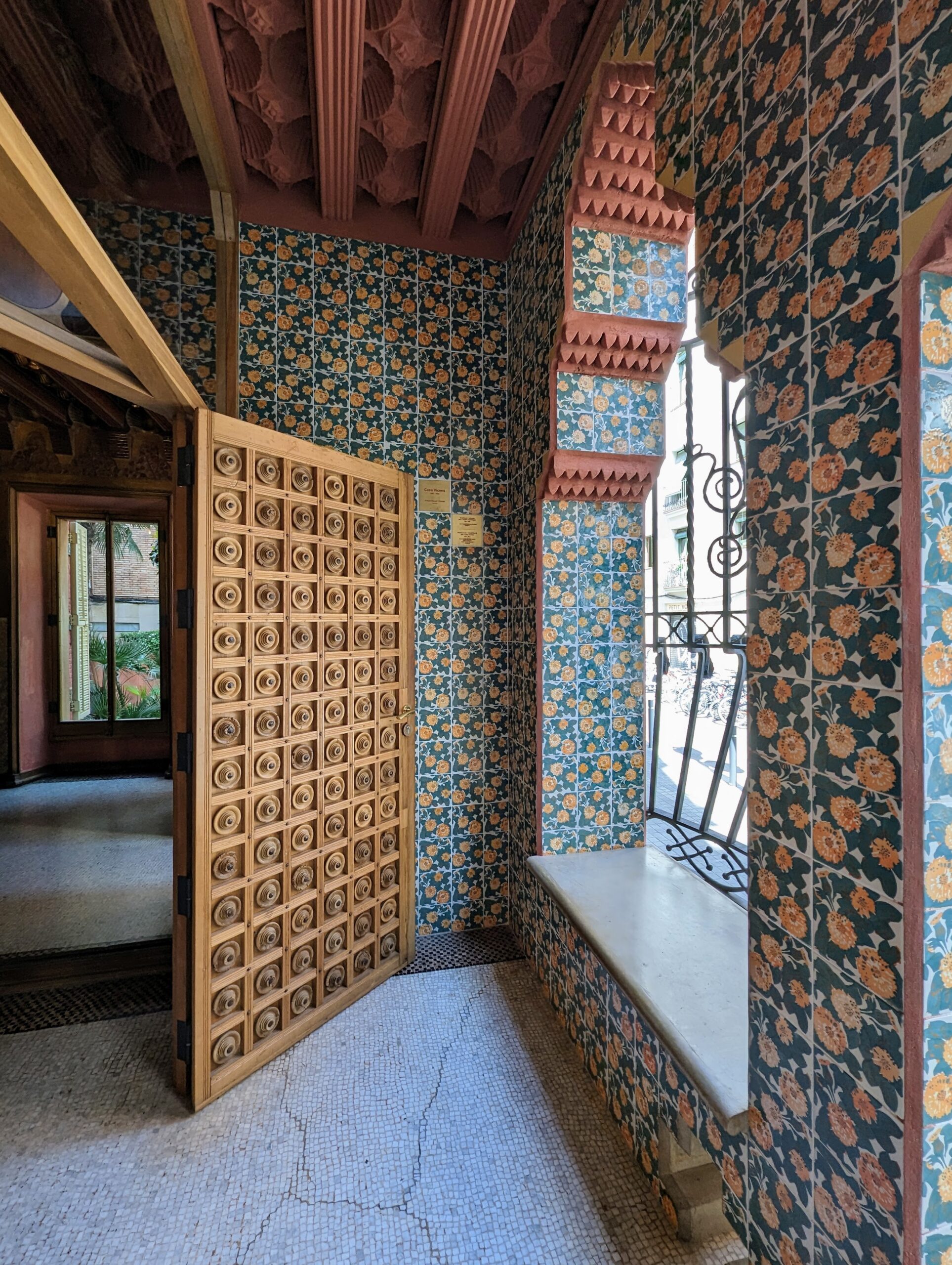
The wooden entrance door, decorated with a grid pattern set with circular mouldings, leads to the vestibule, which features a wooden-beamed ceiling with polychrome mouldings and sgraffito (drawings created by hatching or scraping white plaster over a black or colored background) with plant motifs on the walls.
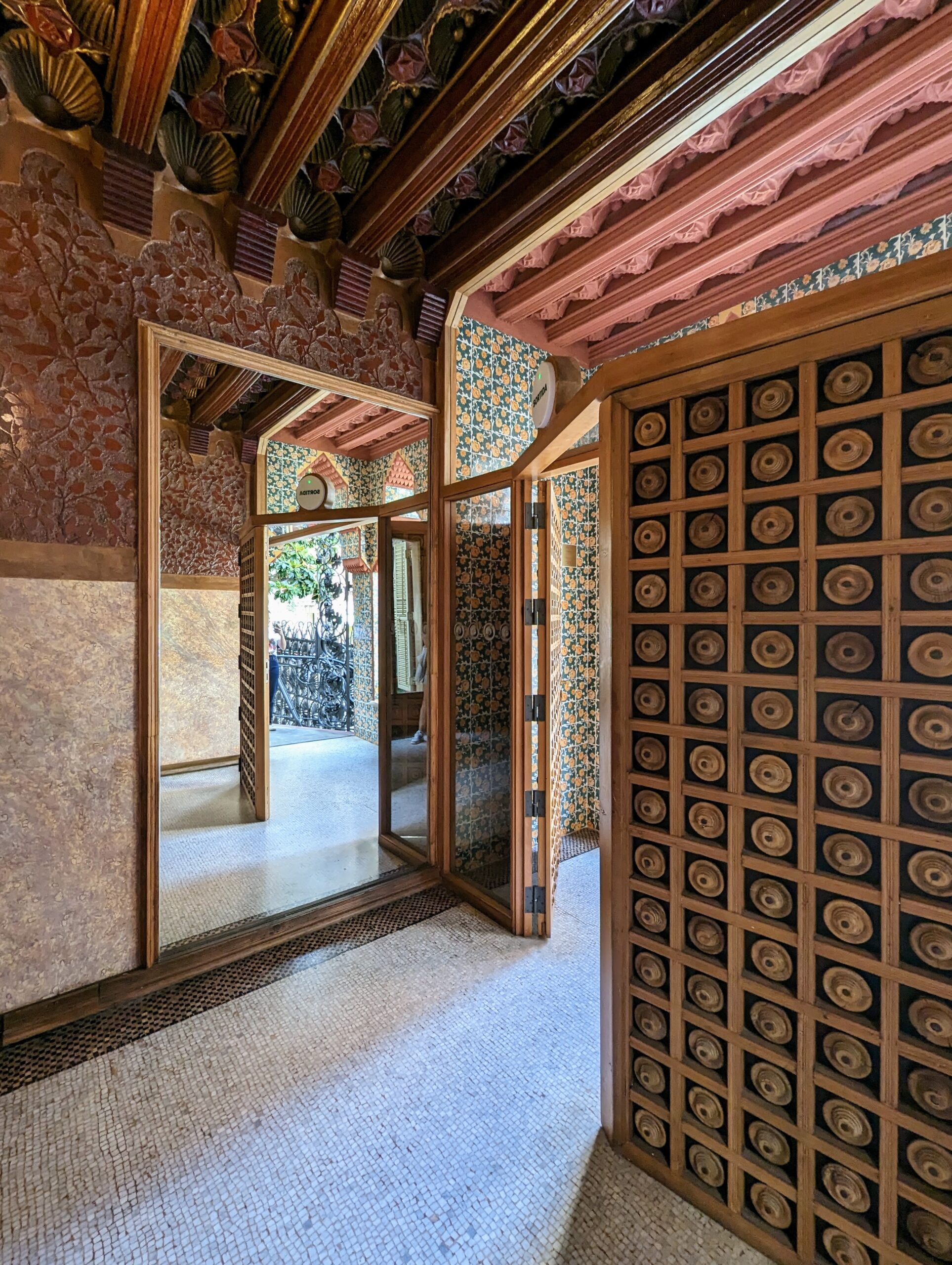
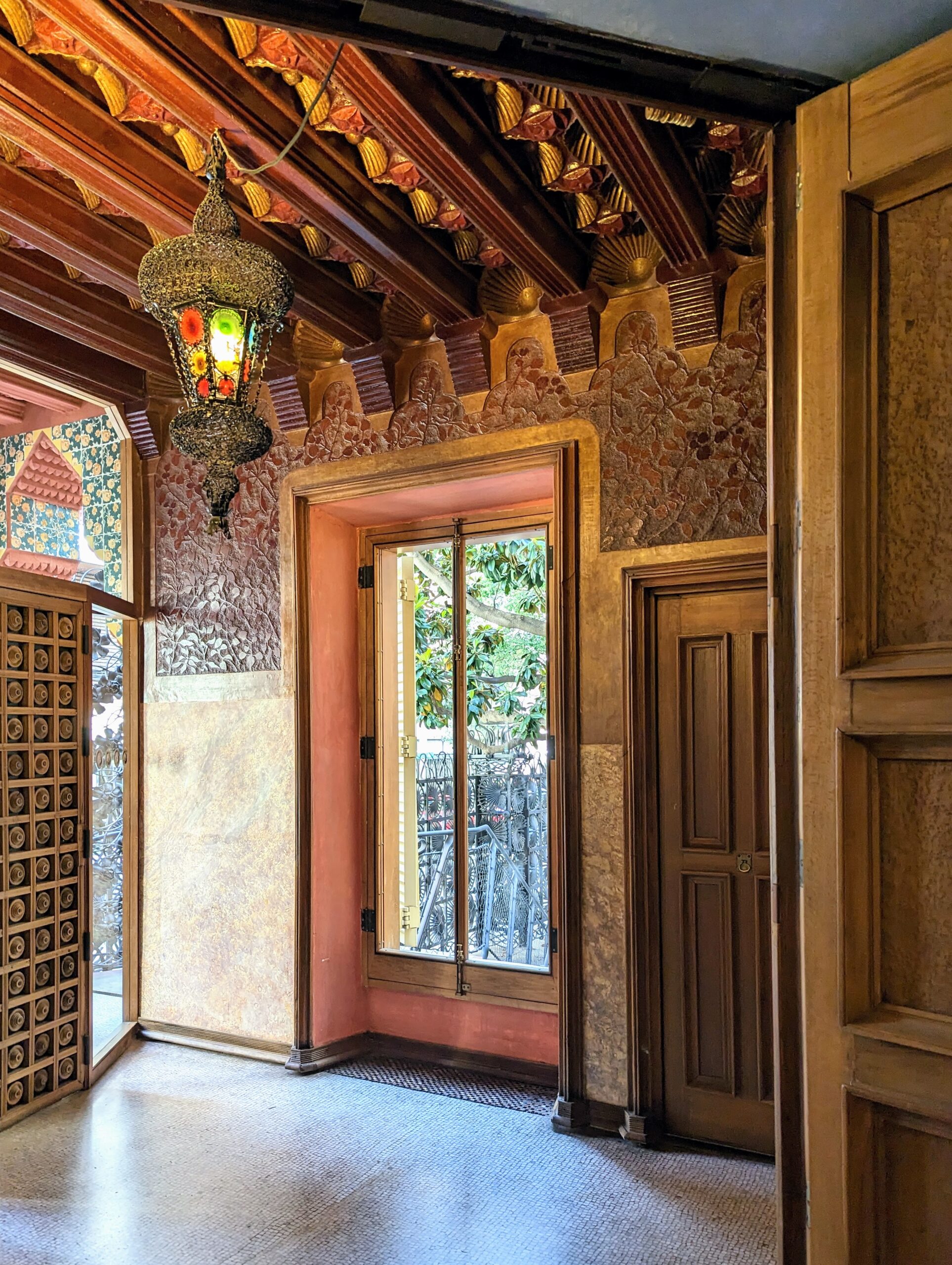
Beyond the vestibule, the dining room is the central space, surrounded by a covered gallery (projecting window) and a smoking room.
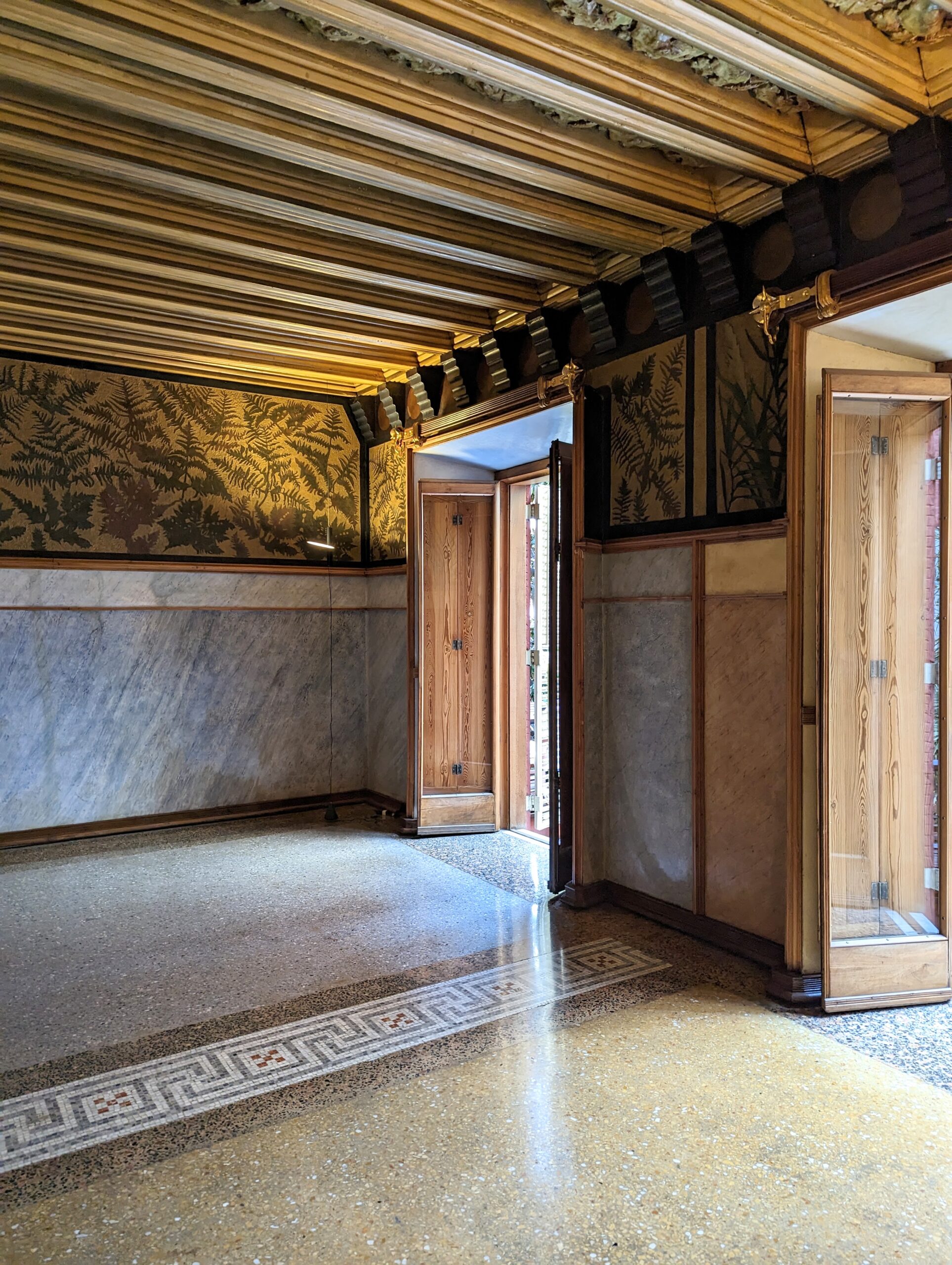
The dining room is a veritable work of art, combining architecture and decoration. Unwooded, untiled surfaces are decorated with climbing ivy in stucco on a gold background, alternating with stoneboard (an imitation of stone for moldings and ceiling decorations) with fruit and arbutus leaves between the ceiling beams. The floor is in antique-style Roman mosaic.
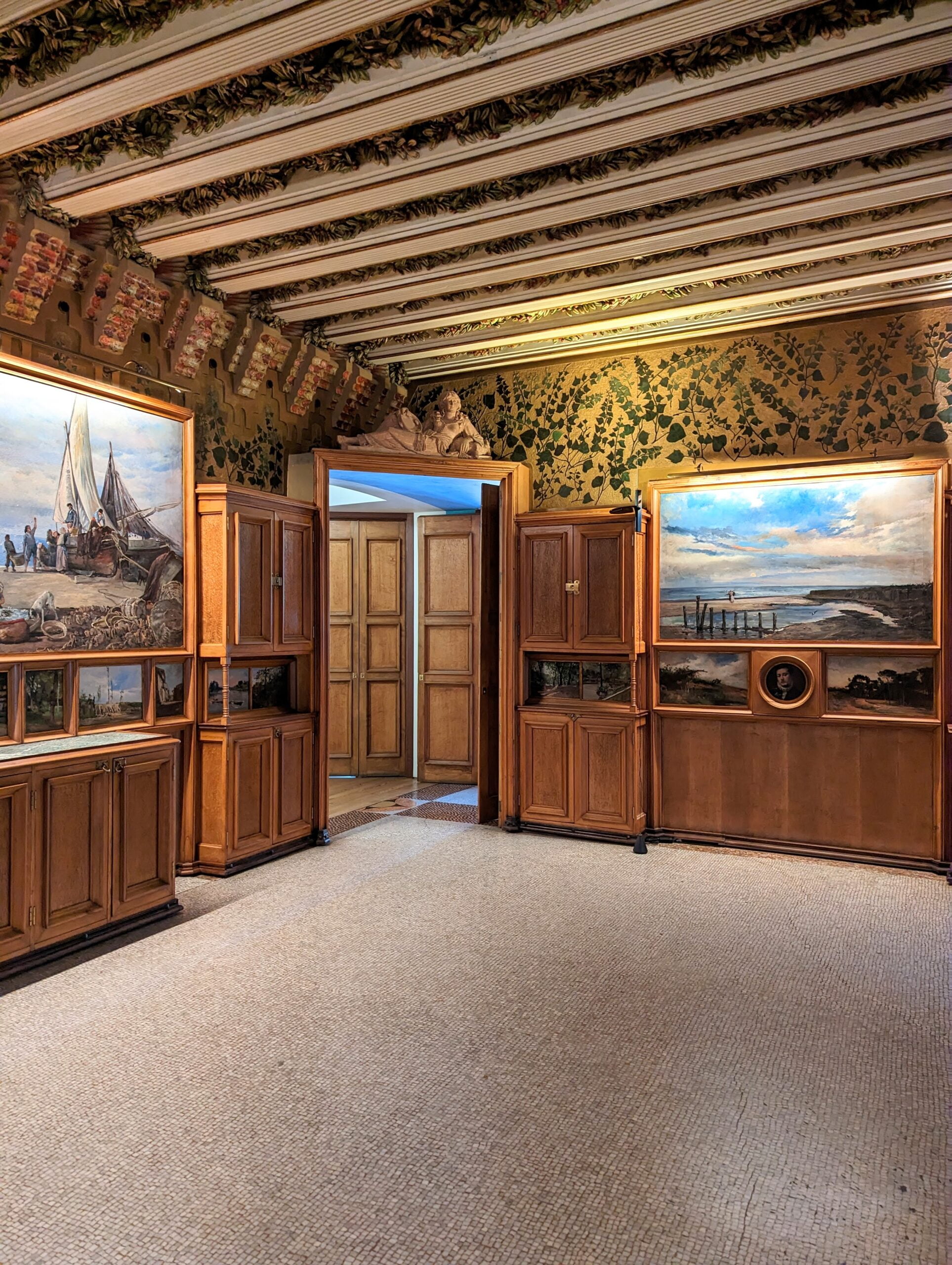
The jambs separating the dining room from the covered gallery are decorated with paintings by Francesc Torrescassana depicting natural motifs, including several species of birds. The wooden furniture, designed by Gaudí, forms an ensemble with the frames housing other paintings by Torrescassana.
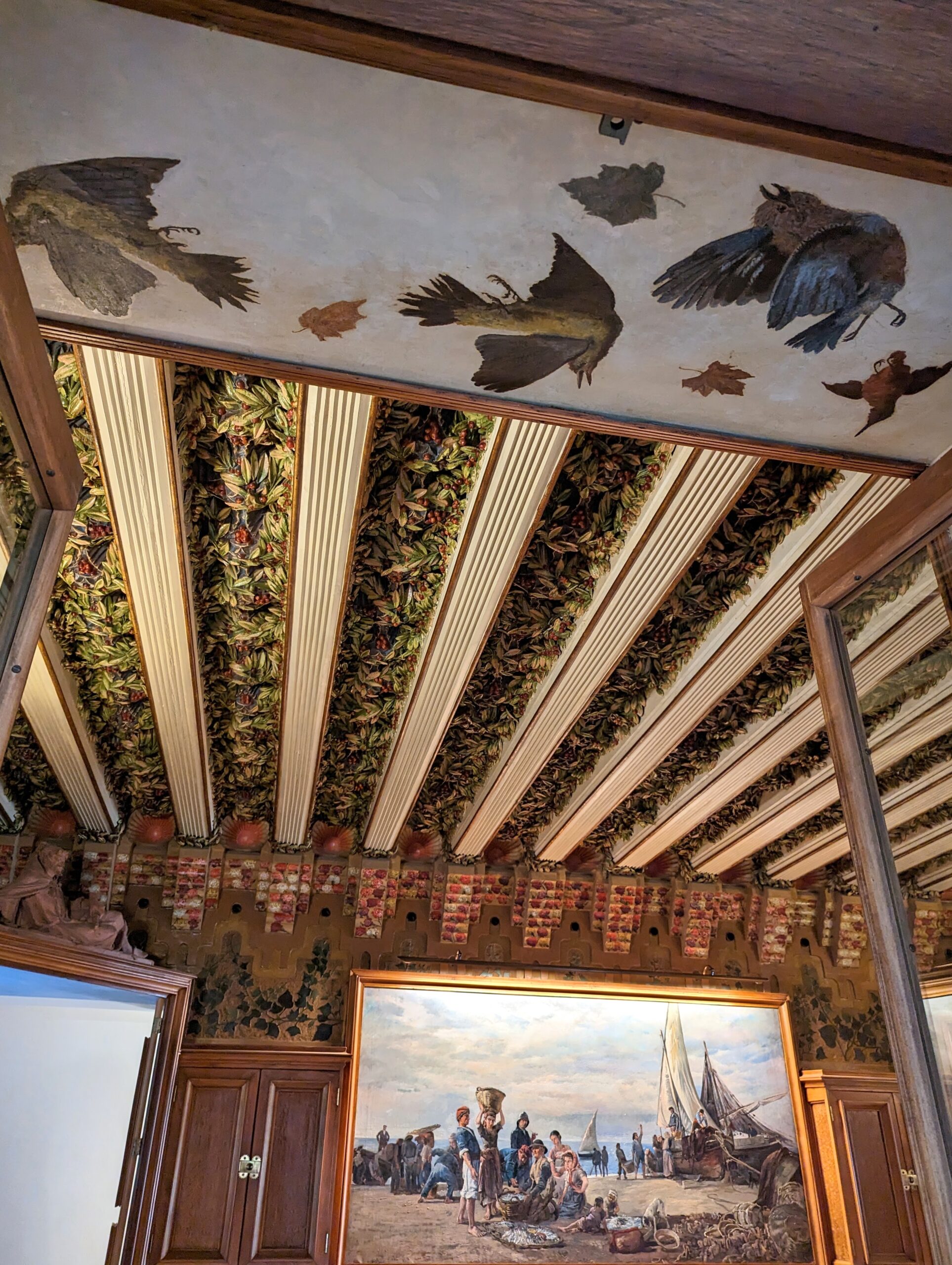
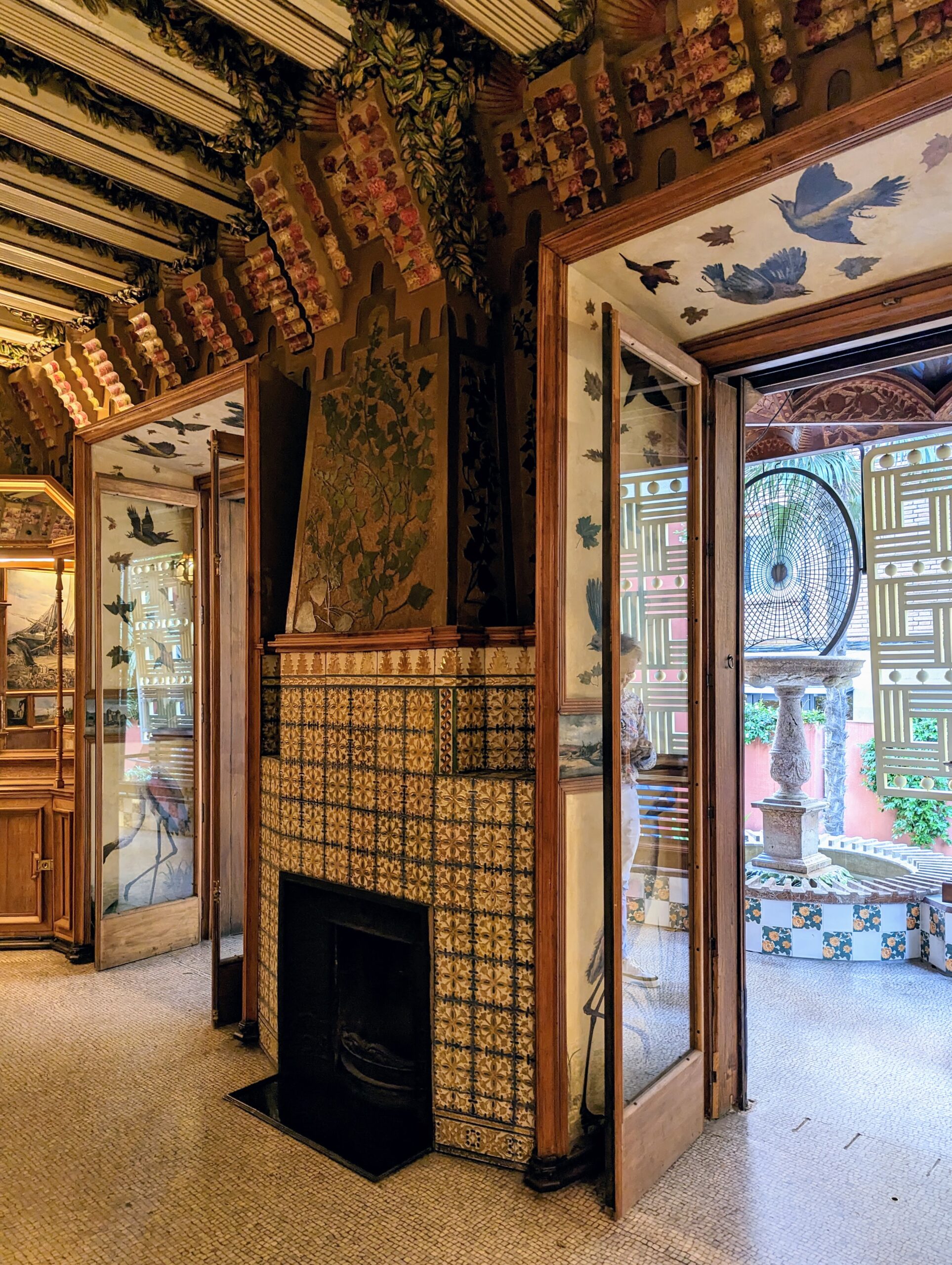
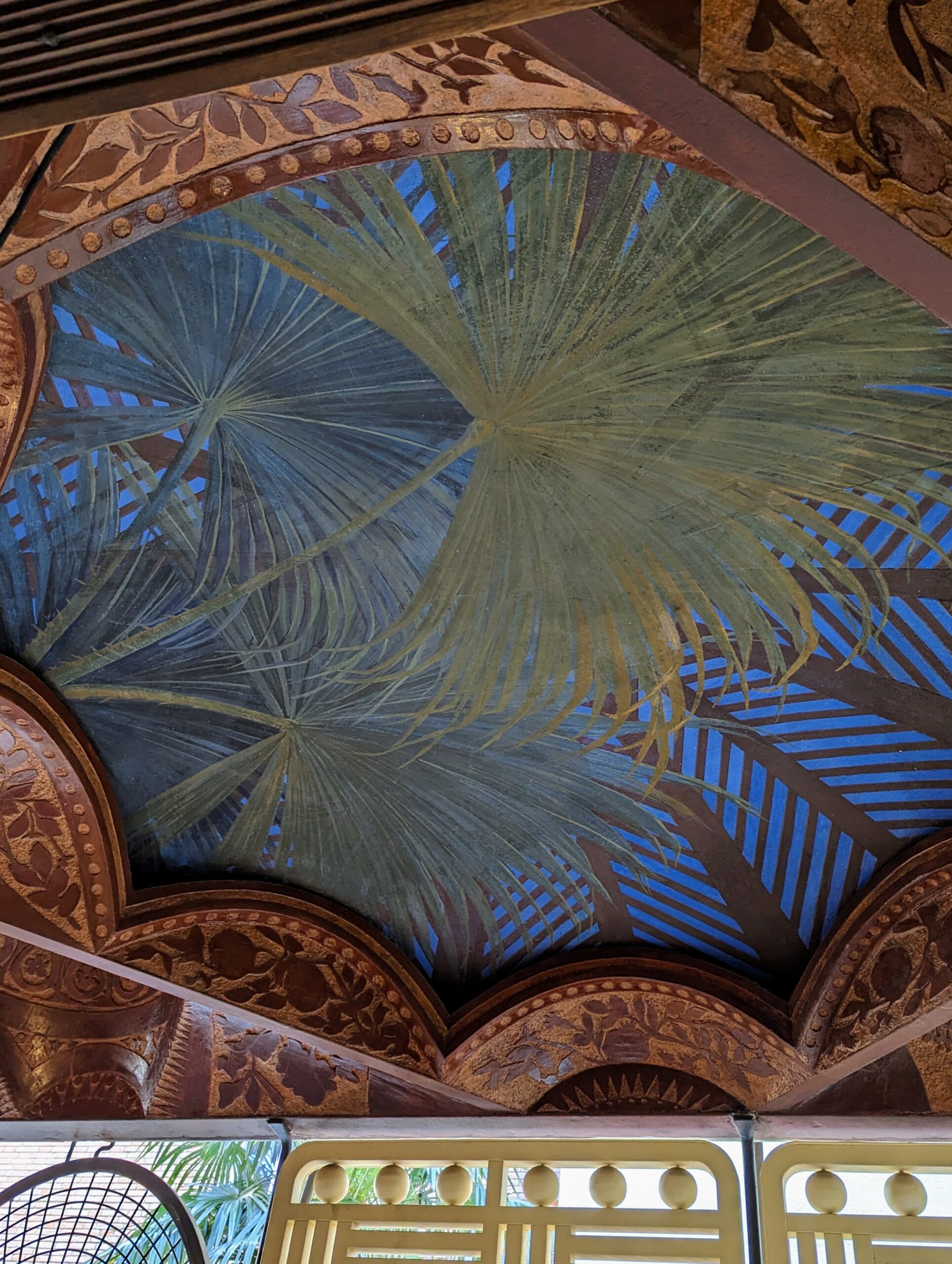
The dining room opens onto a bay window with an oriental-inspired wooden louver system. In the center is a fountain whose base is covered with ceramic tiles adorned with carnations. The ceiling features sgraffito with pomegranate and hydrangea motifs, and a trompe-l’oeil painting of a sky seen through palm leaves.
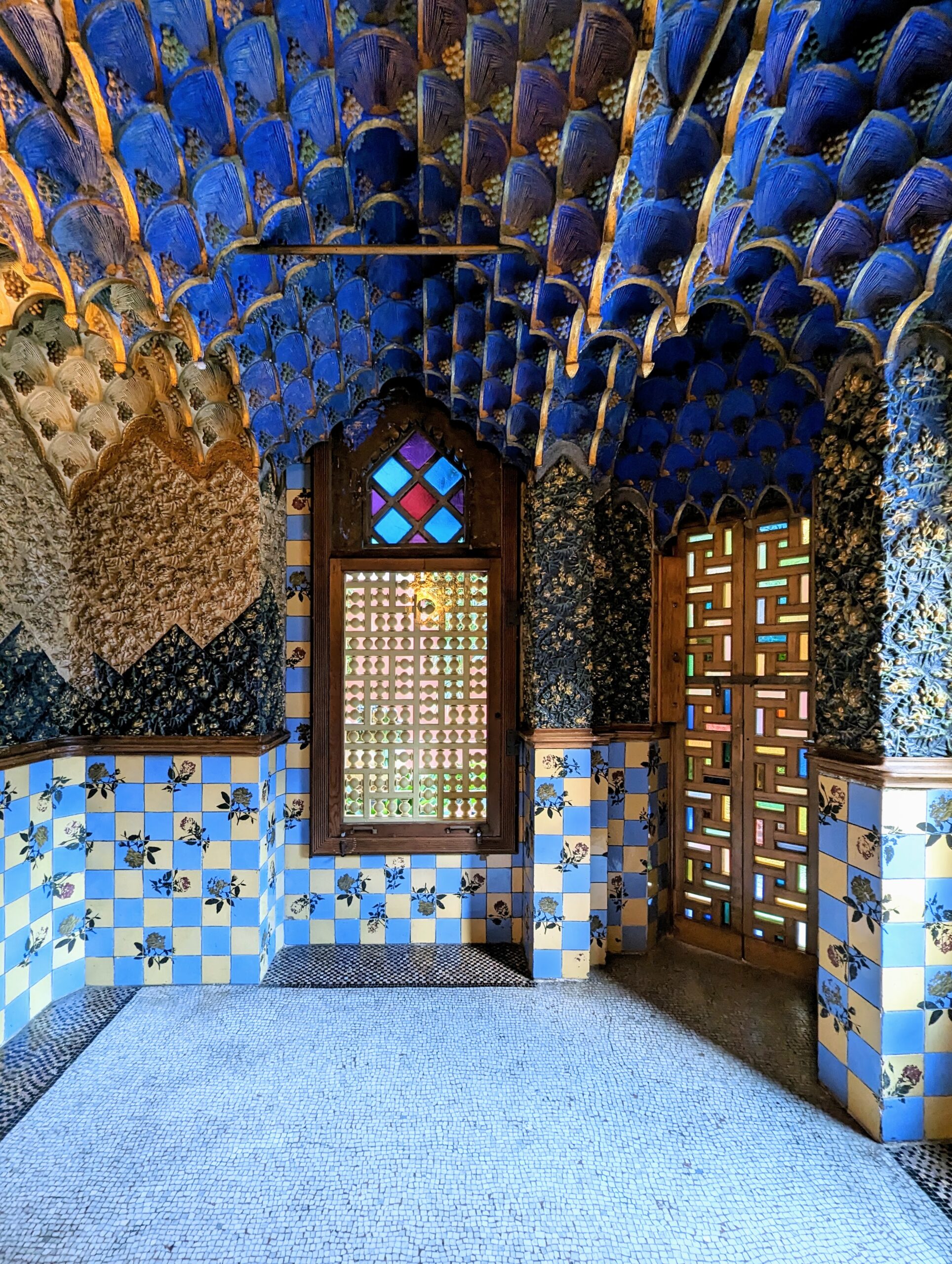
Adjoining the dining room, the smoking room is undoubtedly the most impressive room in Casa Vicens, with its false ceiling formed by a structure of muqarnas (honeycomb-shaped decorative elements from Islamic architecture) in polychrome plaster depicting palm leaves and bunches of dates. The walls are covered with polychrome cardboard tiles in shades of gold, blue and green, while the blue and ochre base is decorated with oil-painted red and yellow roses. The wooden door leading to the garden has a Chinese-style frame.
Second floor
The second floor features private rooms: several bedrooms, including a guest room, a bathroom, a checkroom with washbasin, a living room and a room probably used as an office or library. Most of the rooms are decorated with frescoes featuring plant motifs, all inspired by plants found by Gaudí in the Cassoles stream next to Casa Vicens.
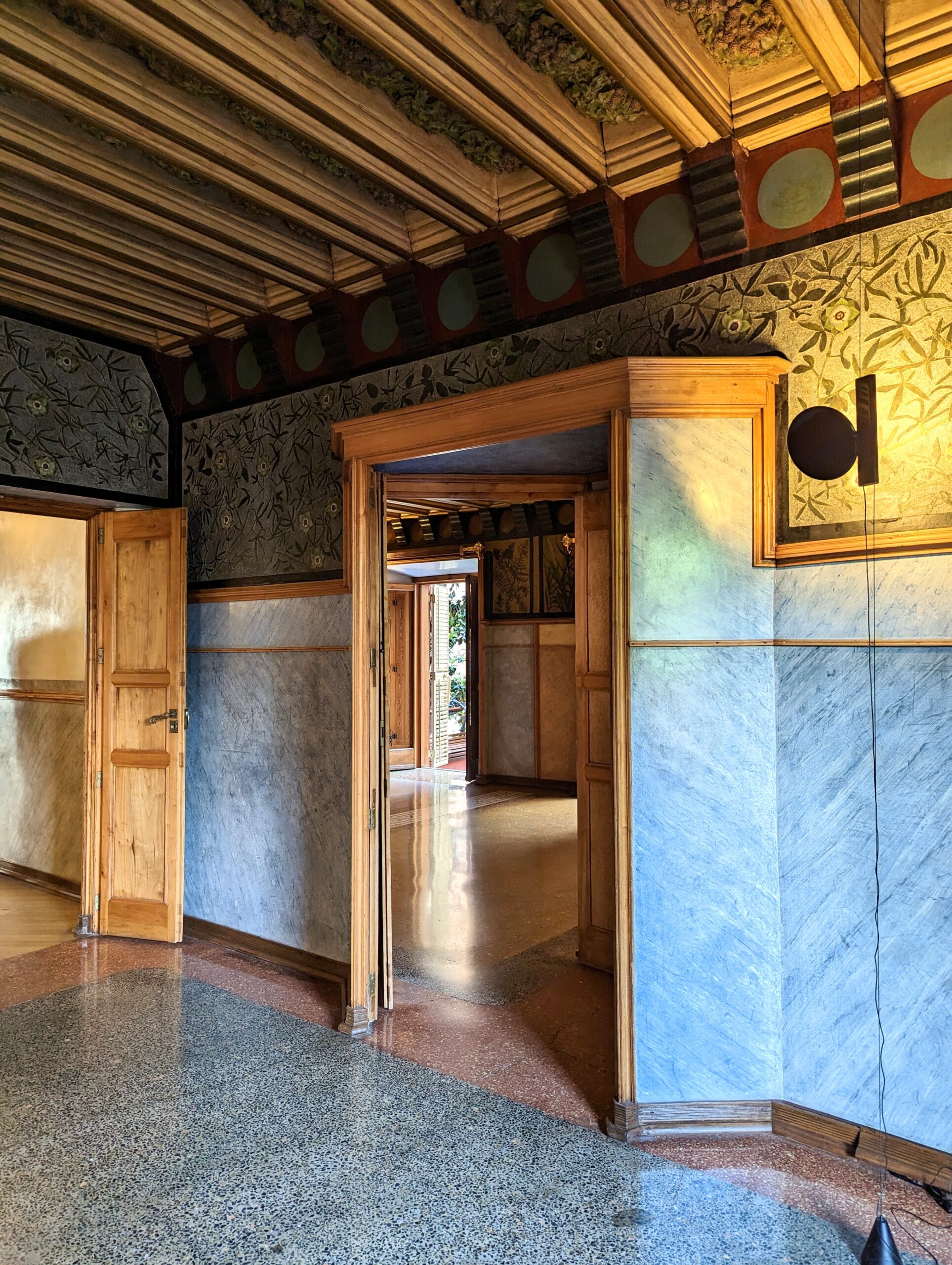
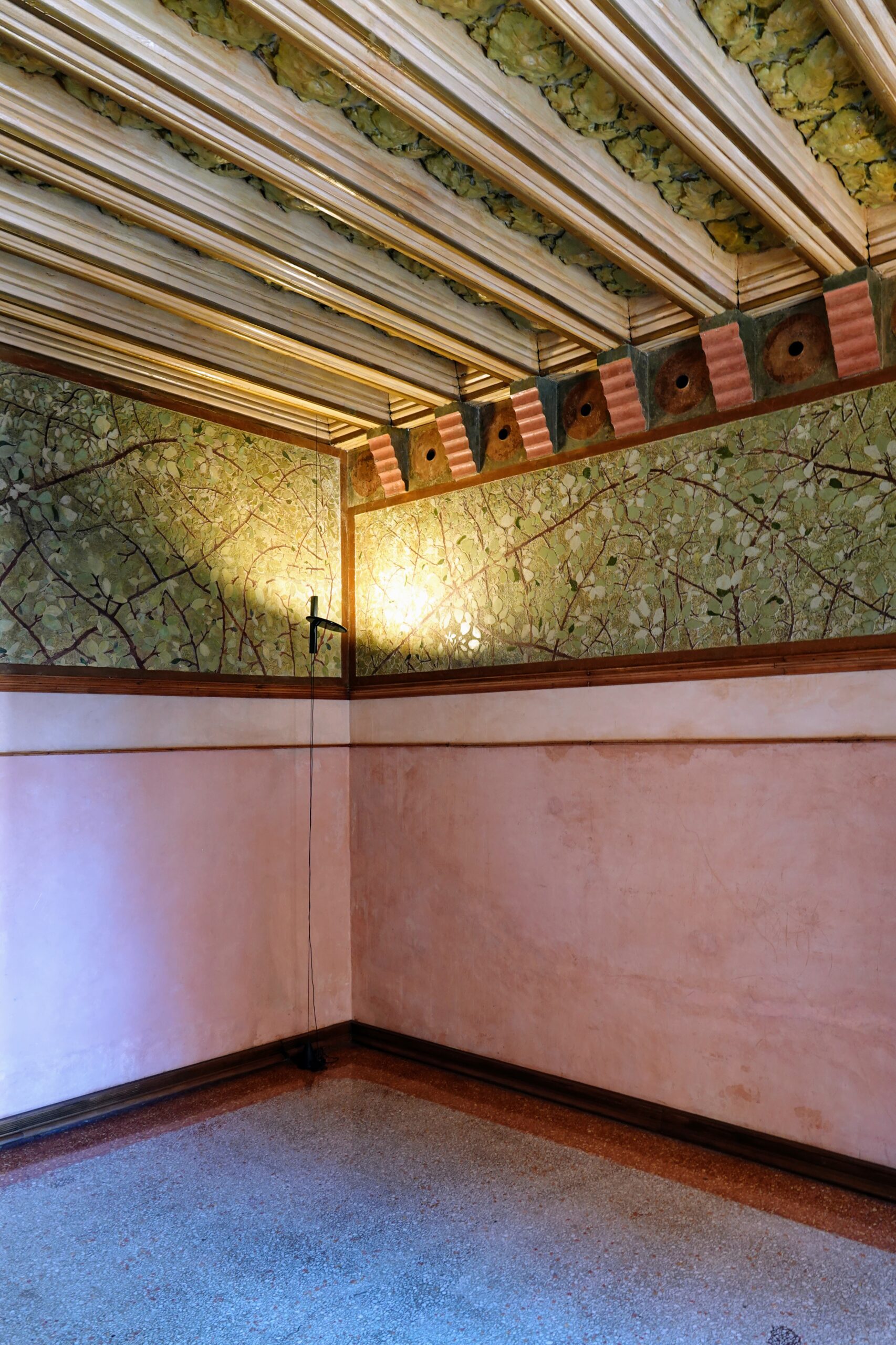
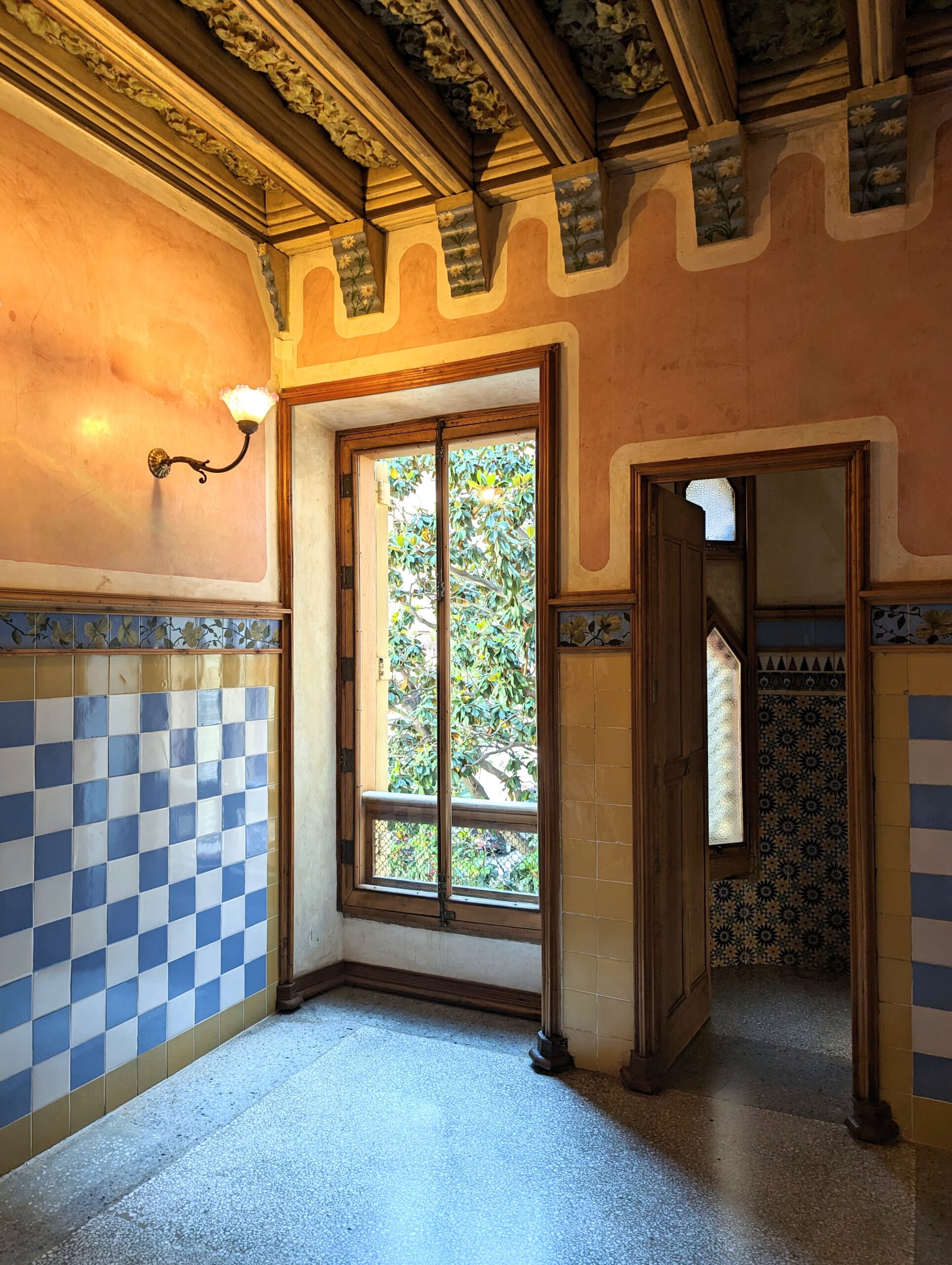
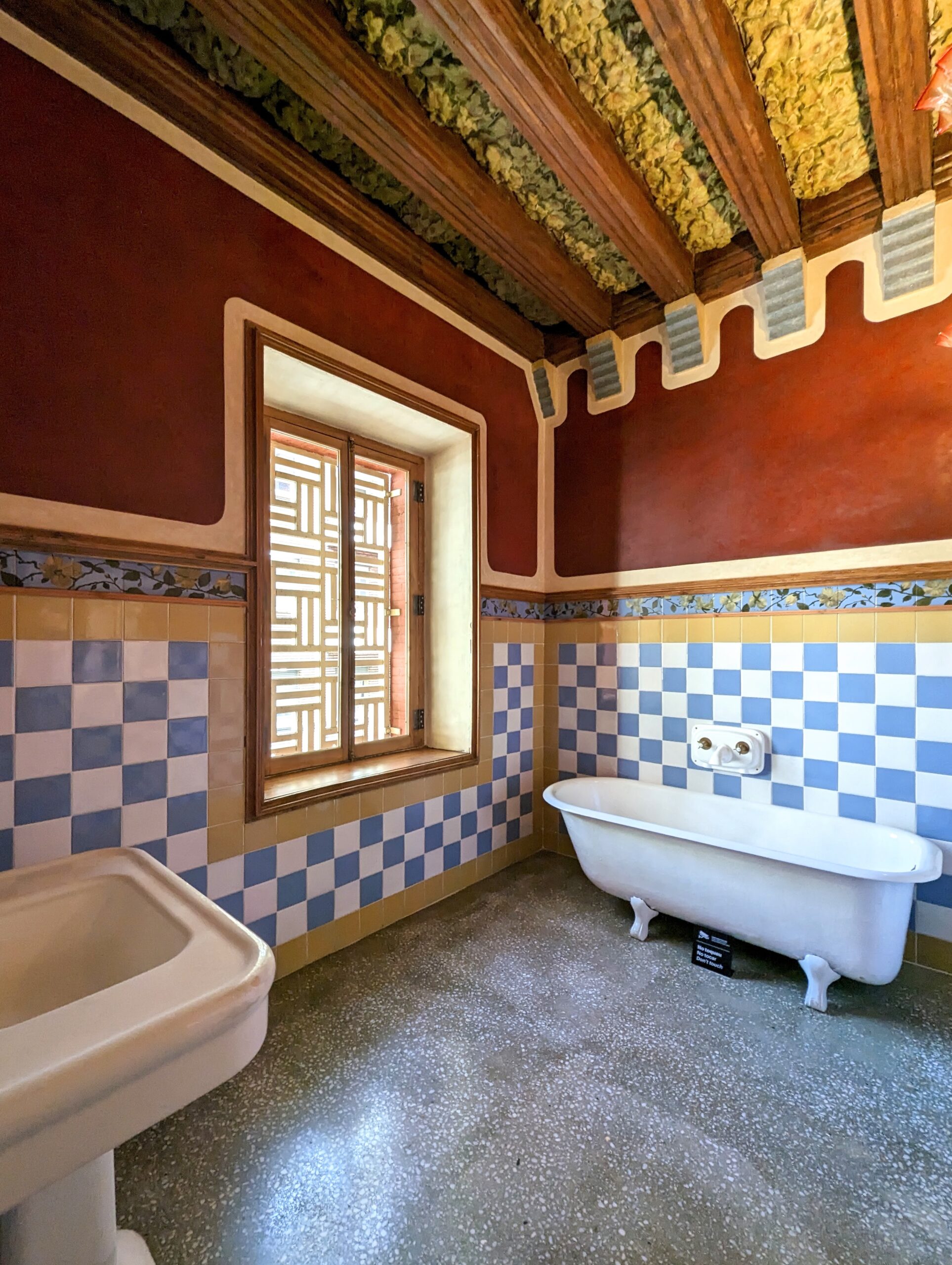
In the checkroom and bathroom, the ceilings are decorated with beams with ceramic reliefs of ivy leaves, the floor is in gray terrazzo and the walls are tiled with blue and white checkerboards and tile friezes with oil-painted flowers.
Located above the dining room, the master bedroom overlooks the garden. Boasting a large terrace built on the first floor’s covered gallery, this room benefits from plenty of natural light.
The ceramic ceiling frame is decorated with vine tendrils in green polychrome papier-mâché. The walls are covered with a layer of stucco symbolizing reeds and rushes on one side, ferns on the other. Always mindful of the smallest details, Gaudí ensured that the floral motifs in the master bedroom differed according to the space dedicated to each person.
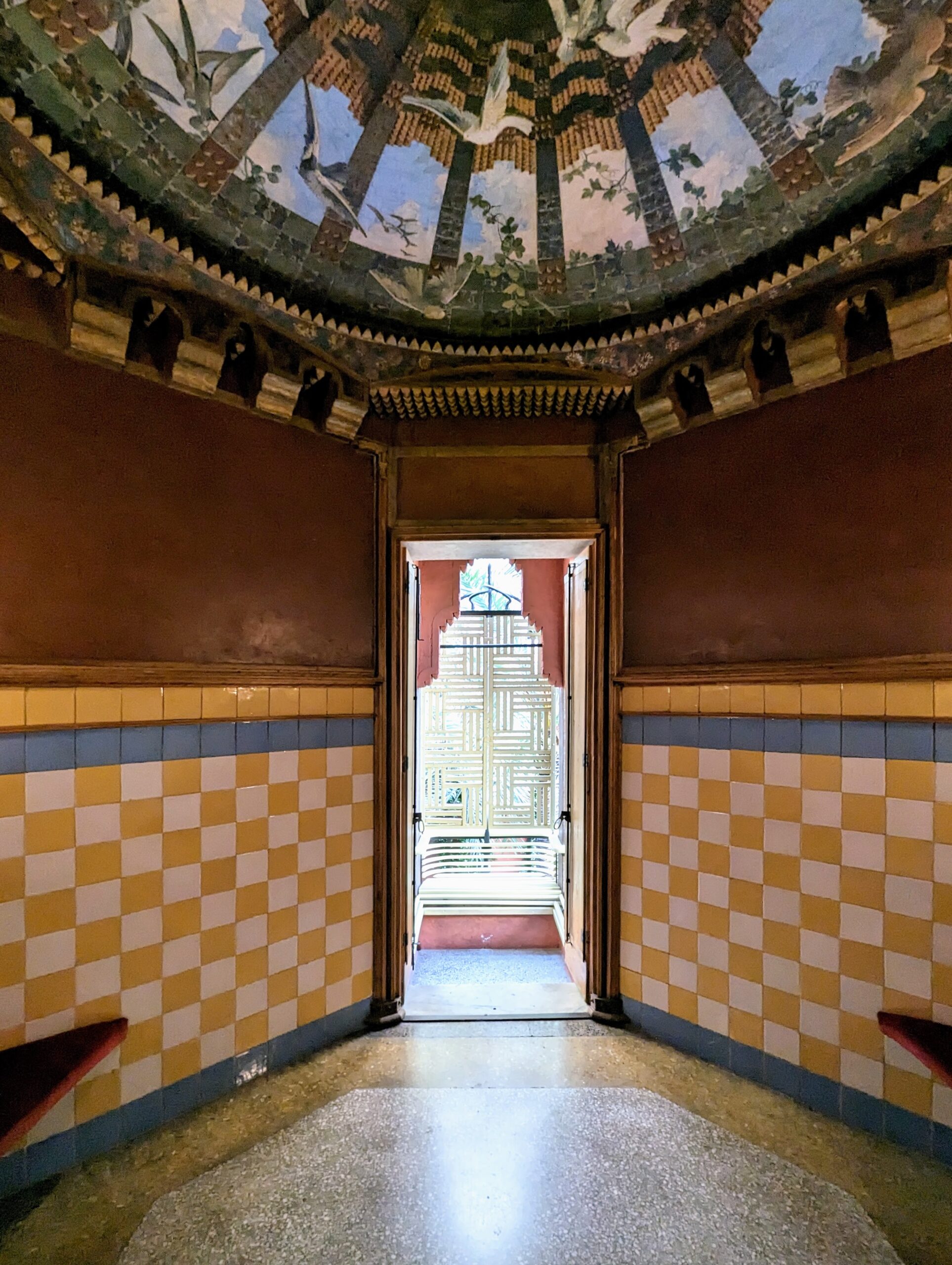
Above the smoking room is a small lounge with a ceiling dome decorated with a Baroque trompe-l’oeil painting of birds in flight. The lower section features a checkerboard of blue, white and ochre ceramic tiles.
Second floor
Once used as staff bedrooms, the second floor is more austere, with plain walls, flagstone floors and wood-beamed ceilings. It is now dedicated to theCasa Vicens permanent exhibition. The exhibition includes several models of the original Casa Vicens project.
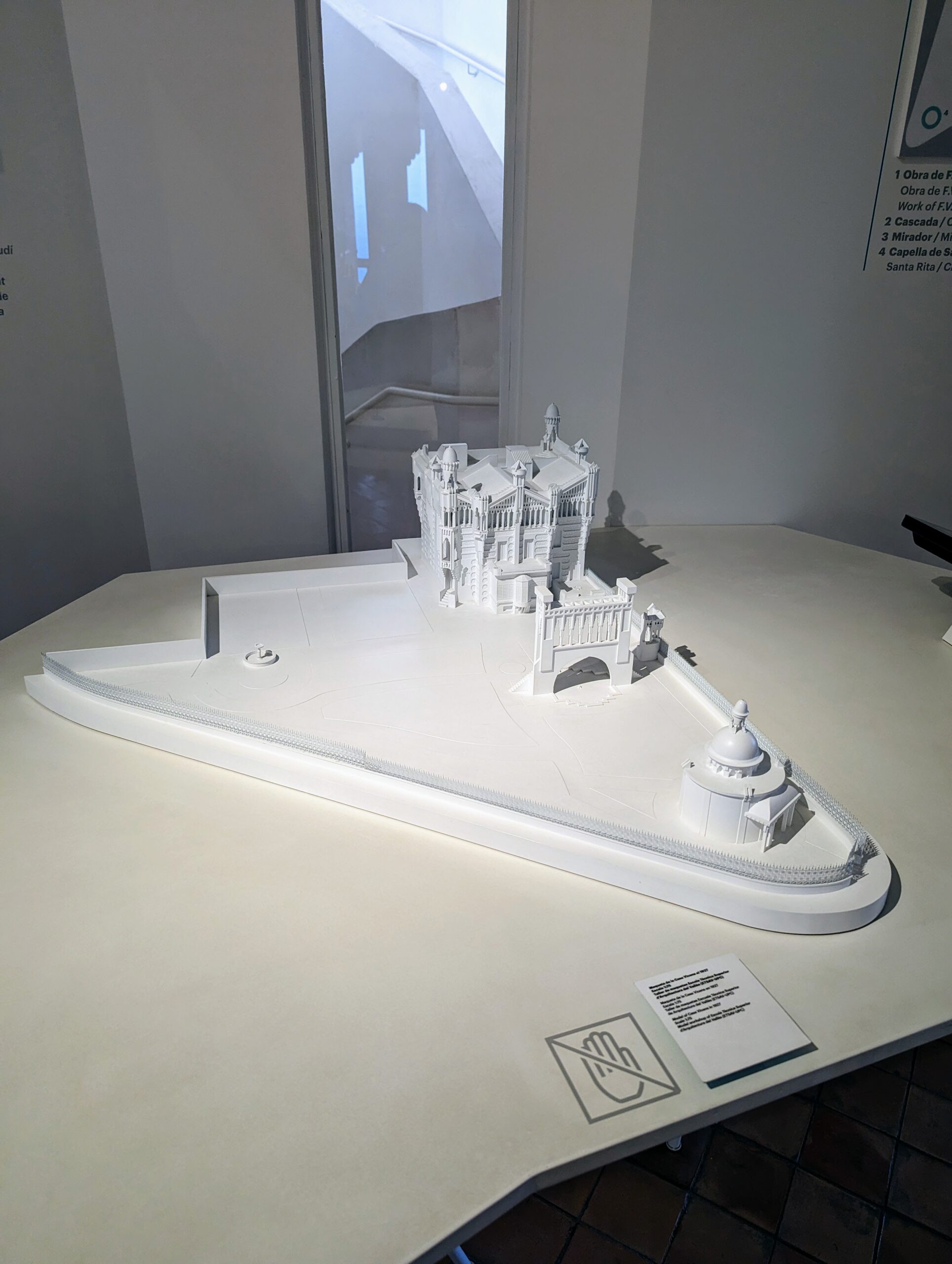
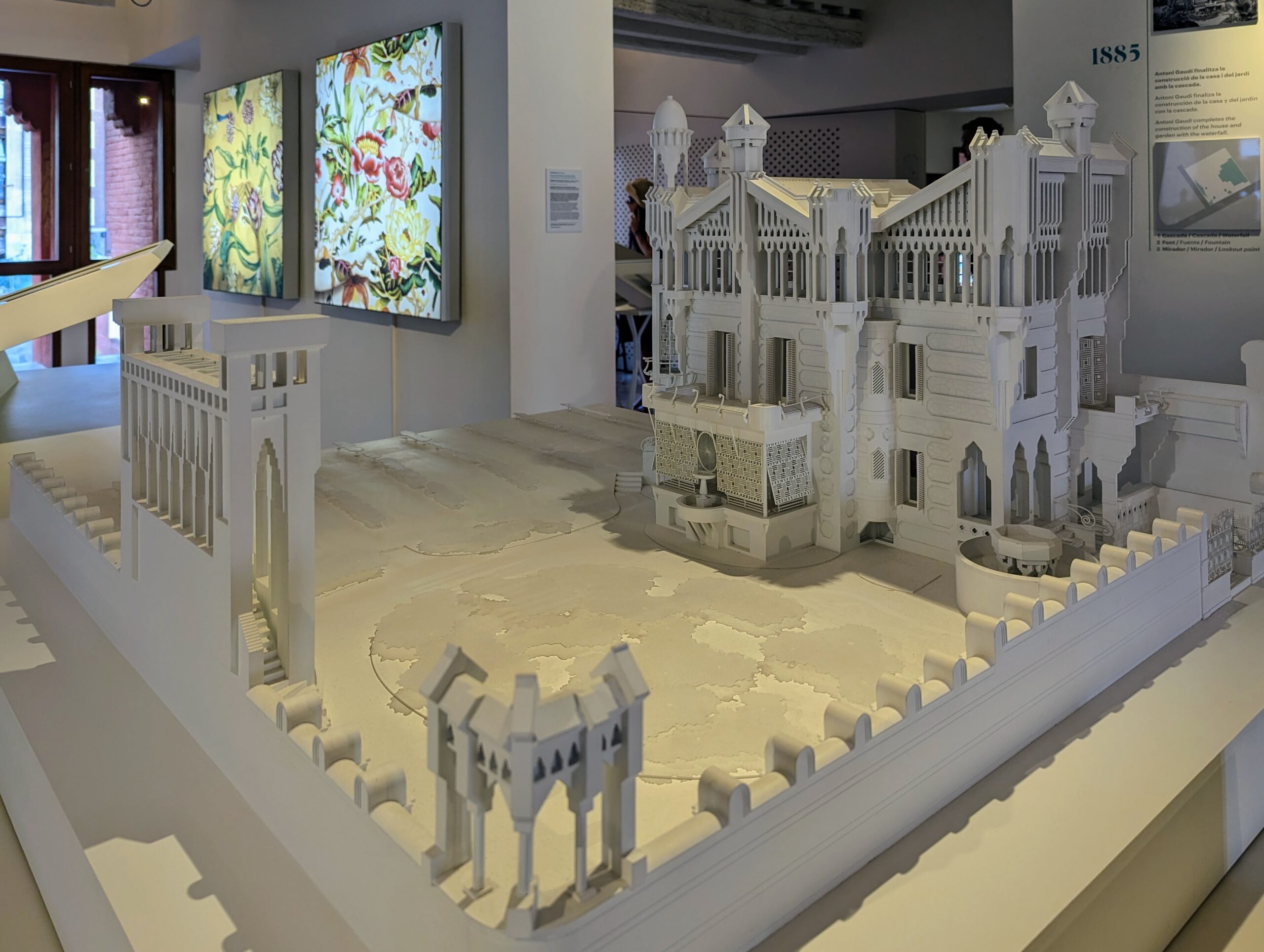
The tour ends in the basement, with its Catalan vaulted ceiling. Once used as a cellar and coal cellar, it now houses the museum store.
Practical Information
- Casa Vicens is located at Carrer de les Carolines, 20-26, in the Gràcia district. Access is by metro (Fontana stop), bus (lines 22, 24, 27, 87, 114, H6, V17, D40, N4) or on foot (Casa Vicens is a 25-minute walk from Parc Güell, for example).
- Casa Vicens is open daily from 9:30 a.m. to 6:00 p.m. from November to March and from 9:30 a.m. to 8:00 p.m. from April to October. Casa Vicens will be closed on December 23, 2023, January 6, 2024 and from January 8 to 17, 2024 inclusive for maintenance and restoration work.
- Admission is €18 per adult. Admission is free for children under 12.
- The Casa Vicens ticket includes access to a full audio guide.